
Insights & news
Complete Guide to Bagasse Clamshell Containers
A bagasse clamshell looks simple. Hinged fiber box, tab closure, holds a burger or a plate lunch. Then a saucy short rib soaks through before the delivery rider reaches the customer. That is when buyers learn the category is not plug-and-play. The bagasse clamshell has become a default eco-format for takeaway, delivery and catering. Sourcing it well means matching fiber recipe to menu, hinge to delivery route, and certificate pack to market. This guide covers the practical details that show up after the first container lands at port.
Product Overview
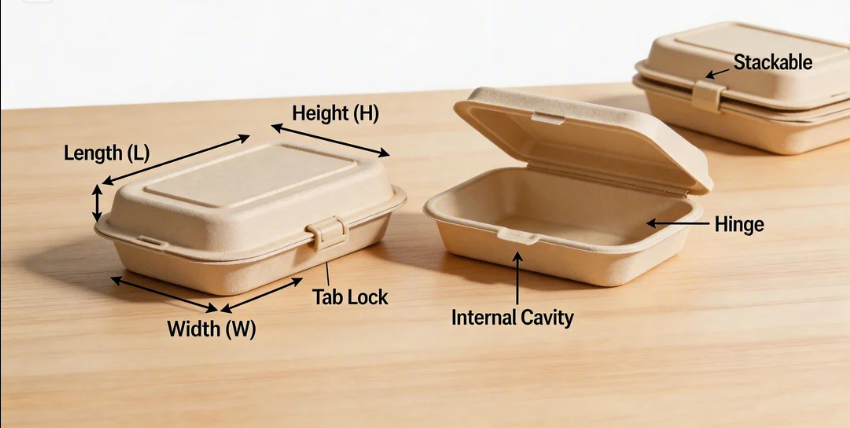
A bagasse clamshell is a one-piece hinged container molded from sugarcane fiber. Base and lid are formed together. No separate lid to inventory, lose or assemble. Staff open, fill, close, stack. That is the quiet operational advantage.
Formats range from quick-service burger boxes and meal-prep trays to catering entrées, school lunch containers, cloud-kitchen packaging and supermarket grab-and-go. Single-compartment clamshells suit burgers, sandwiches and simple entrées. Two- and three-compartment versions handle plate-style meals—protein on one side, rice or potatoes on the other, vegetables or sauce kept apart.
Sizes are quoted by footprint: 6-inch, 7-inch, 8-inch, 9-inch, 10-inch, plus rectangles such as 9 × 6 inches. A “9-inch” from one factory is not the same as another’s. Internal cavity, lid height and usable volume differ enough to change carton packing and menu performance. Ask for internal dimensions, not nominal size. A clamshell can have plenty of length and width and still fail if the lid will not clear a tall burger or a piled-on portion.
Materials
The raw material is sugarcane bagasse—the fibrous pulp left after cane is crushed for juice. It is a by-product, so the material story holds up better than most bio-plastic narratives. No dedicated land, no extra crop cycle, no food-versus-fuel tradeoff. “Bagasse” and “sugarcane fiber” mean the same thing in the trade.
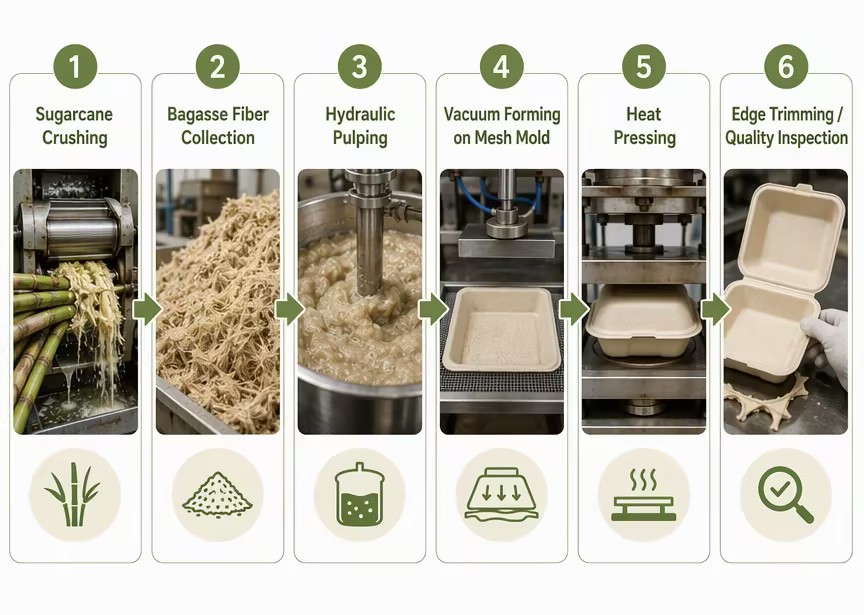
Making a clamshell is a wet process. Bagasse goes into water, breaks into pulp, and is pulled onto a mesh mold by vacuum. The wet layer is pressed between heated tools. Heat and pressure remove moisture and fuse fibers into a rigid shape. The rim is trimmed so the hinge lines up and the lid closes with a click, not a gap.
A good clamshell can be 100% bagasse fiber with no PLA coating and no petroleum-based additives. Some producers bleach pulp for white; others leave natural beige. White looks cleaner on shelf. Natural hides stains better and reads as more honest.
Grease and moisture resistance is where the conversation gets real. Bagasse has a history with PFAS, the chemicals once used to repel oil and water. The market has moved toward PFAS-free formulations, and most serious suppliers offer them. But removing PFAS can reduce grease resistance versus old chemistry. PFAS-free does not automatically mean gravy-proof. Test the specific SKU against the specific food.
Applications
Bagasse clamshells shine when food is hot, holding time is minutes rather than hours, and the container must survive a delivery bag. Burgers, fried chicken, hot sandwiches, grain bowls, breakfast platters, pasta, deli meals, sliced pizza and catering entrées are the sweet spot.
The practical heat ceiling is around 220°F for most formulations. Many versions are microwave-safe. That matters for customers reheating leftovers and operators wanting one container from pass to delivery to microwave.
Wet, sauce-heavy food held for long periods is the weak point. A curry or soup will find the fiber. A fried item sitting in oil for an hour can leave a translucent patch. The fix is not abandoning the material; it is matching format. A bowl-and-lid system or a verified high-grease-barrier container is better for those menus. Many operators run a mixed program: clamshells for hot, drier entrées, bowls for wet items. That is good packaging hygiene, not a compromise.
Multi-compartment clamshells deserve attention. A three-compartment 9 × 9 × 3-inch format is basically a plate in a box. Protein, starch and vegetable stay separate. Sauce does not migrate into rice. Presentation survives delivery. For catering and meal-prep brands, that separation is often worth more than a few cents per unit.

Advantages
The first advantage is structural. Molded fiber is stiff. It does not buckle like thin paperboard when four containers stack in a delivery bag. The integrated hinge tolerates repeated opening and closing, and tab-lock closures can resist compression in packed bags.
The second is operational. One piece means one SKU to count and one motion to pack. Containers nest for storage, so a kitchen does not need a separate lid station. In high volume, those seconds add up.
The third is market positioning. Bagasse clamshells can carry industrial compostability certification under EN 13432 in Europe and ASTM D6400/BPI in North America. Some also qualify for home composting under standards such as NF T51-800. That is more than a website logo. In a growing number of jurisdictions, compostability documentation is a procurement requirement. Single-use plastic restrictions now touch more than 140 countries, and foodservice containers are commonly targeted.
Trade-offs are honest. Bagasse clamshells are opaque—no window into the food. Delivery-only brands selling on presentation may see that as a downside. They are bulkier than foam, roughly 30% more space per unit, which changes storage planning. They cost more than basic plastic or foam per piece, though the gap narrows at volume. A typical 8 × 8 bagasse clamshell at 50,000-piece MOQ lands around $0.18–$0.25 per unit, depending on specification and barrier treatment.
Customization
Customization is more capable than many buyers expect. Footprint, depth, compartment layout, lid clearance, venting, closure style and stackability can all be tooled. A deeper lid or wider hinge clearance is a mold decision, not a material limitation.
Branding runs from subtle to loud. Embossing and debossing give a tactile logo without ink—good for natural fiber. Flexographic, screen and full-color printing are available for stronger shelf presence. Custom colors can differentiate product lines or match a brand palette. Surface finish can range from smooth to natural molded texture.
OEM and ODM support is common among Chinese and Southeast Asian factories. The rule: customization should not silently break certification. If pulp recipe, coating or additive package changes, compostability and food-contact reports need rechecking. A pre-production sample from final tooling is non-negotiable.

MOQ
MOQ is where sustainability narrative meets spreadsheet. In molded fiber, MOQ exists because every SKU runs on its own mold, and each run carries setup cost that only makes sense above a certain volume. Industry MOQs commonly fall between roughly 5,000 and 50,000 pieces per SKU, depending on product and customization.
The key words are per SKU. An 8-inch clamshell and a 9-inch three-compartment clamshell are separate setups with separate minimums. You cannot average them into one order and expect a single run. Mixed containers—some clamshells, some bowls, some trays—can spread freight and improve container utilization, but each SKU still clears its own MOQ floor.
Customization raises the floor. Stock white or natural standard sizes carry lower minimums. Private-label printing, custom embossing or a bespoke mold pushes MOQ up because tooling and setup must be absorbed. For a first order, validate the format with a stock SKU, run menu tests, then commit to custom tooling once specification is locked.
Lead Time
Lead times follow a rhythm, but the headline number rarely tells the whole story. Samples typically take 5–7 days. Mass production of standard products commonly runs 8–10 days. Custom or high-volume orders more often land in the 18–28 day range. Some factories quote around 30 days for OEM/ODM programs.
What stretches those numbers? Custom tooling fabrication, peak season, Chinese New Year and holiday shutdowns, inland transit to port, documentation and inspection. A factory quoting “25 days” without saying whether the clock starts at deposit, artwork approval or sample sign-off is giving a number, not a schedule. Ask for milestone dates. For a private-label launch, build a two-to-three-week buffer. It is cheaper than air-freighting clamshells.
Certificates
Certificates are where a folder of PDFs can look impressive and still leave you exposed. Certificates are issued per product and per manufacturing site, not per brand or material category. A compostability certificate covering coated paper does not automatically cover an uncoated bagasse clamshell from the same factory.
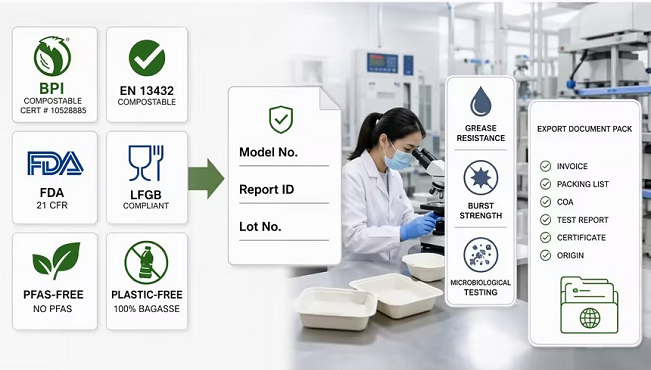
For industrial compostability, buyers ask most for EN 13432 in Europe and ASTM D6400/BPI in North America. BPI is often the practical gatekeeper for North American composting facilities, which may reject compostable packaging without it. TÜV Austria and DIN CERTCO also appear, including OK Compost and home-composting certifications such as NF T51-800.
For food-contact safety, FDA compliance is the baseline for the U.S. market. LFGB is the strictest EU food-contact regulation and is routinely requested by European distributors and retail brands. EU 1935/2004 and FDA 21 CFR compliance sit alongside those depending on destination.
Then there are claims without a single certificate: plastic-free (no PLA coating, no petroleum-based additives) and PFAS-free. Both need documentation tied to the specific SKU, not a website statement. A supplier that maps certificates to model numbers, report IDs, validity dates and production lots is a lower-risk partner than one that sends a brochure and calls it compliance.
FAQ
Are bagasse clamshells microwave-safe? Most are, but “most” is not “all.” Bagasse handles hot food contact above 100°C. Confirm the exact SKU, and do not microwave the lid unless rated.
Can they handle saucy or oily food? For short holding, yes. A curry held for an hour or fried food sitting in oil will absorb. Match container to food, or specify a higher grease barrier.
Compostable vs. biodegradable? Compostable is a defined, certifiable claim with a timeline and required end product. Biodegradable is looser—sometimes meaningful, sometimes marketing. Ask for the certificate, not the adjective.
Do bagasse clamshells contain PFAS? Many do not, but the category has history. Request PFAS-free documentation and test grease performance with real food.
What MOQ should I expect? Roughly 5,000–50,000 pieces per SKU. Stock molds sit lower; custom-printed or custom-tooled products sit higher.
Can I get custom branding? Yes—embossing, debossing, flexo and full-color printing. Expect higher MOQ and longer lead time.
Are they recyclable? They are designed primarily for composting. Food-contaminated fiber is generally not accepted in paper recycling, but certified compostable clamshells can go to industrial composting where infrastructure exists.
Comparison Table
| Factor | Bagasse Clamshell | PLA Clamshell | EPS Foam Clamshell | Rigid Plastic (PP/PET) | Coated Paperboard |
|---|---|---|---|---|---|
| Heat tolerance | High; hot food above 100°C; microwave-safe in most formulations | Low to moderate; warps at high heat | Moderate; holds heat but can deform | Moderate to high; depends on polymer | Moderate; softens with hot, moist food |
| Grease/oil resistance | Good to very good when specified; PFAS-free versions need validation | Good for cold; limited for hot grease | Good | Good | Variable; coating-dependent |
| Structural rigidity | High; keeps shape under stack pressure | Moderate | Moderate to low | High | Moderate |
| Visibility | None | High (clear) | None | High (clear versions) | None |
| Compostability | Certified industrial and home options | Industrially compostable in commercial facilities | Not compostable | Not compostable | Limited; coating-dependent |
| Cost position | Moderate; higher than basic paperboard/plastic | Higher than conventional plastic | Low | Low | Moderate |
| Best fit | Hot entrées, burgers, bowls, multi-compartment meals | Cold items, deli, clear-lidded displays | Short-hold takeaway | Wet or sauce-heavy foods | Dry or low-moisture items |
Bagasse wins on heat, rigidity, natural aesthetics and compostability. PLA wins on visibility and cold display. Foam is cheap but increasingly regulated out. Rigid plastic remains the benchmark for wet, sauce-heavy food. Coated paperboard is a lower-cost fiber option but trails bagasse on heat and structure.
Sourcing Considerations and Factory Reality Check
Market data says bagasse clamshells are no longer niche. The global sugarcane tableware market was valued around $3.49 billion in 2025 and is tracking toward $6.05 billion by 2035, with clamshell containers holding about 31.5% of the container segment. The buying question is not “is there enough material?” It is “can I get the right SKU, with the right paperwork, at the right time, from a factory that will still be there on the second order?”
Factory-level experience matters. Consider Tonchant Earth, in packaging since the mid-2000s and heavily into biodegradable food-contact materials since around 2017. It runs an 11,000-square-meter workshop, operates its own physical testing lab for permeability, burst strength and microbiological indicators, and holds SC, ISO 22000 and ISO 14001 certifications. Its compostability credentials include TÜV Austria, DIN CERTCO, BPI and ABA, with product-level registrations traceable to specific models. That traceability matters when a retail customer or port authority asks for proof, not a promise. Tonchant also pairs low MOQ flexibility with factory-direct pricing and export experience across 80-plus countries—workable for a distributor testing a new size or a restaurant group rolling out private label.
A practical scenario: a 15-location fast-casual chain switches from foam to an 8 × 8 bagasse clamshell. The first order looks right and the price is acceptable. Then two problems surface. The clamshells take roughly 30% more storage space, forcing extra dry storage across locations. And the “heavy-duty” sample that performed in the test kitchen warps under a heat lamp during catering. Neither is a material failure. Both are specification and planning failures. Asking about storage density, heat-lamp exposure and real holding conditions before the PO avoids both.
Another: a meal-prep brand packs chicken thigh, rice and roasted vegetables into a three-compartment clamshell. Moist but not saucy, under an hour holding, then customer microwaves it. Bagasse is close to ideal. The same brand tries coconut curry in the same SKU and gets bleed-through by day one. One fiber spec cannot carry every menu item. A mixed-format program is often the professional answer.
Sourcing habits separate smooth programs from painful ones. Confirm whether MOQ is per SKU or per order, and whether the factory will combine SKUs in one container. Plan container loading by volume, not weight—bagasse is light and bulky. Ask for certificate packs with report IDs and model mapping, not a logo sheet. Test lid fit, steam release, oil resistance and delivery stability with actual food. Check shelf-life guidance: stored above 70% relative humidity, bagasse clamshells can start to degrade within about 12 months, so warehousing is part of the specification.
Conclusion
The bagasse clamshell is mature, but not a commodity like a foam box. The fiber source is simple. Performance variables are not. Heat, grease, moisture, stack pressure, lid clearance, storage density, certification scope and end-of-life infrastructure all decide whether a clamshell works in the field or fails in the delivery bag.
Buyers who get it right follow a similar path. They start with the food and route, not the catalog. They validate a stock SKU before custom tooling. They ask for certificates mapped to the exact product and production site. They treat MOQ, lead time and container planning as one commercial equation. And they choose factories that can show a lab, a traceable certification trail and a track record that survives the second order, not just the first sample.
For operators replacing foam or rigid plastic, the bagasse clamshell is a credible, certified, plastic-free route that does not sacrifice heat performance or rigidity. For distributors and private-label brands, it is a category with real growth and regulatory tailwind. The work is in specification and sourcing discipline. Do that work, and the clamshell does its job—quietly, reliably, one hinged lid at a time.