Insights & news
Benefits of Compostable Lunch Boxes: A Buyer’s Guide
Foam is cheap, and it is getting pushed out. Rigid plastic performs well and carries a growing regulatory and reputational bill. Paperboard looks responsible right up until a hot, moist meal turns it into a soggy lid. That is the fight the compostable lunch box has walked into—and mostly, it is winning.
Mostly. Because a compostable lunch box is not automatically a good lunch box. The fiber, the barrier treatment, the certification and the closure all decide whether it survives a delivery bag or collapses under a plate lunch. This guide covers the benefits honestly, plus the sourcing details that determine whether they survive contact with a real menu.
Product Overview
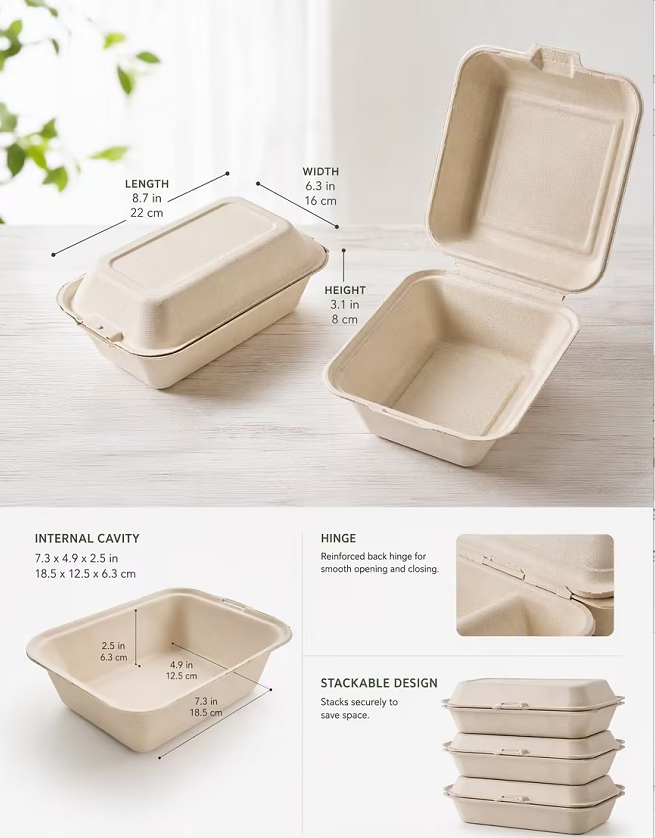
A compostable lunch box is a food container built to break down in a controlled composting environment at the end of its life, leaving no toxic residue and no persistent microplastic behind. The label covers several formats: hinged clamshells, two-piece box-and-lid sets, bento-style compartmented trays, bowl-and-lid systems, and paperboard boxes with a compostable lining. What ties them together is not the shape. It is the certified end-of-life claim.
The most common build is molded fiber, usually sugarcane bagasse or a blend of bagasse and other plant fiber. Molded fiber lunch boxes are rigid, stackable and microwave-safe in most formulations, and they handle hot food contact above 100°C. They also feel substantial in a way thin paperboard never does.
A second family uses paperboard with a compostable water-based or PLA coating. Lighter and cheaper, better for printing, but generally less rigid and less heat-tolerant than molded fiber. A third, smaller group uses compostable bioplastic—PLA or a starch blend—either as a standalone container or as a clear lid on a fiber base. These offer visibility but tend to have lower heat tolerance and a shorter credible shelf life in a hot kitchen.
Treat “compostable lunch box” as a performance claim first and a material label second. The question is not what it is made of. It is whether it survives your food, your holding time and your delivery route—and then whether it can actually be composted where your customer lives.
Materials
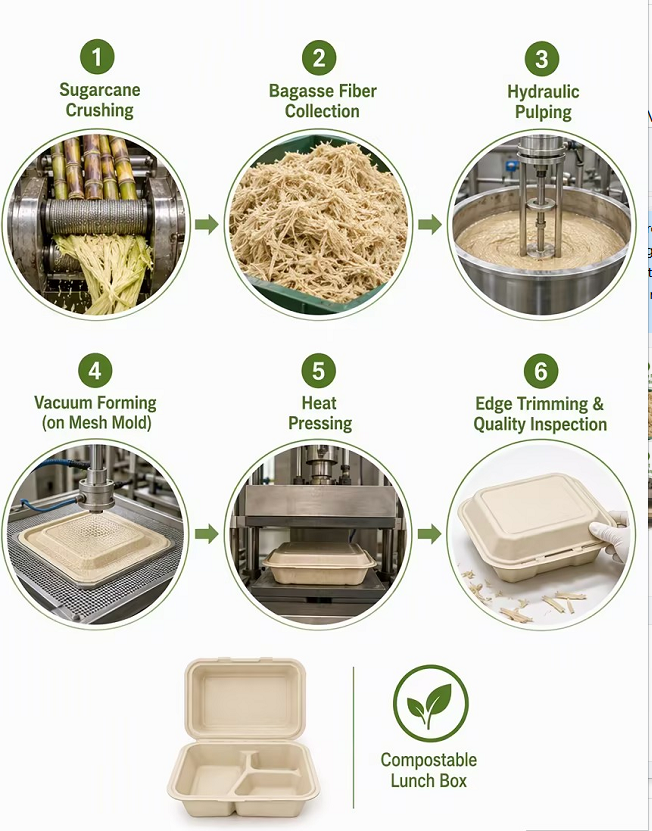
Molded fiber dominates this category for good reason. Sugarcane bagasse is a by-product of sugar production, so the raw material needs no dedicated land, no extra crop cycle and no food-versus-fuel tradeoff. Bagasse is pulped in water, pulled onto a mesh mold by vacuum, then pressed between heated tools until the fibers fuse into a rigid shape. The rim gets trimmed so the hinge aligns and the lid actually closes.
Wheat straw, bamboo fiber and reed pulp show up as alternatives or blends. They behave similarly, with small differences in color, fiber length and stiffness. Bamboo tends to be darker and denser. Wheat straw carries a warmer tone. In practice, the pulp recipe matters less than the additive package and the pressing quality.
That additive package is where buyers should aim their questions. A credible compostable lunch box can be 100% plant fiber with no PLA coating and no petroleum-based additives. Where a coating is used for grease resistance, it should be a compostable coating—not a conventional plastic film hidden behind a green label. PFAS, the chemicals that historically made fiber packaging repel oil and water, have no place in a compostable product. PFAS-free formulations are now standard among serious suppliers, but “standard” is not “universal.”
Paperboard options use a compostable aqueous or PLA-based coating. They print beautifully and cost less, but they are thinner, less insulating and more prone to softening under a hot, saucy meal. For light lunches, pastries, salads and dry items, they are perfectly serviceable. For a curry or a roast dinner, molded fiber is the safer bet.
Applications
Compostable lunch boxes fit a wide range of menus, though not every menu. They perform best with hot, moderately moist food held for a measured period. Burgers, sandwiches, wraps, grain bowls, pasta, rice dishes, breakfast platters, deli meals, sliced pizza and catering entrées all sit comfortably inside the performance envelope.
Cold applications are just as straightforward. Salads, fruit, pastries, sushi-style sets and chilled meal kits work well, provided the container is specified for the moisture level involved. Chilled food does not stress the fiber the way hot, oily food does.
Where the category stumbles is wet, sauce-heavy food held for long periods. A curry, a soup or a heavily sauced noodle dish will find the fiber. A fried item sitting in its own oil for an hour can leave a translucent patch on the base. That is not a material failure. It is a specification mismatch, and the professional answer is often a mixed program: molded fiber lunch boxes for hot, drier entrées, bowl-and-lid systems or high-barrier containers for the wet items.
Institutional buyers deserve their own note. Schools, hospitals, care homes and corporate canteens are among the fastest-growing adopters, because a compostable lunch box solves two problems at once. It addresses procurement mandates around single-use plastics, and it reduces contamination in waste streams where food and packaging get discarded together. In a closed-loop setting with on-site composting, the benefit is even cleaner—the box and the food scraps leave as one stream.

Advantages
The headline benefit is the end-of-life story, and it is stronger than most buyers expect. Certified compostable lunch boxes can carry industrial compostability certification under EN 13432 in Europe and ASTM D6400 or BPI in North America. Many also qualify for home composting under standards such as NF T51-800. That is not a marketing badge. In a growing number of jurisdictions, compostability documentation is a procurement requirement, not a differentiator.
The regulatory tailwind is real. Single-use plastic restrictions now touch more than 140 countries, and foodservice containers are among the most commonly targeted categories. A buyer who specifies a certified compostable lunch box today is, in practical terms, pre-empting a rule that may arrive in two or three years.
Performance is the second advantage. Molded fiber is stiff. It does not buckle like thin paperboard when four boxes stack in a delivery bag, and the integrated hinge tolerates repeated opening and closing far better than a paperboard fold. Tab-lock closures can be tuned to resist the compression that builds up in a packed bag.
Brand perception is the third. A natural-fiber lunch box reads as substantial and deliberate. It signals that the operator thought about the waste stream, and customers notice. For brands selling into offices, schools or environmentally engaged demographics, that signal has commercial value.
The trade-offs deserve equal billing. Compostable lunch boxes are opaque—no window into the food. They are bulkier than foam, roughly 30% more space per unit, which changes storage planning for multi-site operators. They cost more per piece than basic plastic or foam, though the gap narrows at volume. And here is the uncomfortable one: they only deliver their environmental benefit where composting infrastructure exists. In a market with no commercial composting, a compostable lunch box ends up in landfill like everything else. Buyers selling into such markets should be honest about that in their own marketing rather than lean on the adjective.
Customization
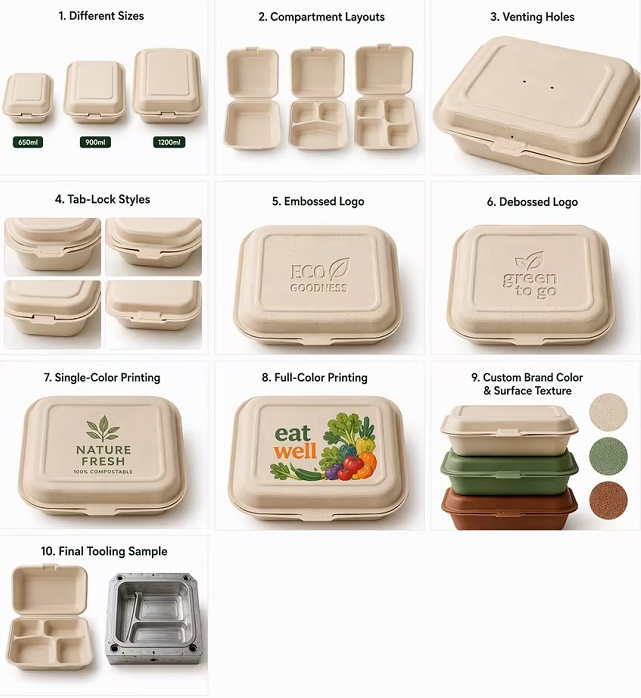
Customization here is broader than most buyers assume. Footprint, depth, compartment layout, lid clearance, venting, closure style and stackability can all be tooled. A deeper lid or wider hinge clearance is a mold decision, not a material limitation.
Branding ranges from quiet to loud. Embossing and debossing give a tactile logo without ink, which suits the natural-fiber look. Flexographic, screen and full-color printing are available for buyers who want stronger shelf presence. Custom colors can separate product lines or match a brand palette. Surface finish can run from smooth to a more natural molded texture.
The one hard rule: customization must not silently break certification. If the pulp recipe, coating or additive package changes, the compostability and food-contact reports need rechecking. A pre-production sample from the final tooling is non-negotiable.
MOQ
MOQ is where the sustainability story meets the spreadsheet. In molded fiber, minimums exist because every SKU runs on its own mold, and each run carries a setup cost that only makes sense above a certain volume. Industry MOQs commonly land between roughly 5,000 and 50,000 pieces per SKU, depending on product and customization.
Read that again: per SKU. An 8-inch lunch box and a three-compartment bento tray are separate setups with separate minimums. You cannot average them into one order and expect a single run. Mixed containers can spread freight cost and improve utilization, but each SKU still clears its own floor.
Customization raises the floor. Stock natural or white standard sizes carry lower minimums. Private-label printing, custom embossing or a bespoke mold pushes MOQ up because tooling and setup have to be absorbed. For a first order, validate with a stock SKU, run menu tests, then commit to custom tooling once the specification is locked. That sequence saves more money than any price negotiation.
Lead Time
Samples typically take 5–7 days. Mass production of standard products commonly runs 8–10 days, while custom or high-volume orders more often land in the 18–28 day range. Some factories quote around 30 days for OEM/ODM programs.
What stretches those numbers? Custom tooling fabrication, peak season, Chinese New Year and other holiday shutdowns, inland transit to port, documentation and inspection. A factory that quotes “25 days” without saying whether the clock starts at deposit, artwork approval or sample sign-off is giving you a number, not a schedule. Ask for milestone dates. For a private-label launch, build a two-to-three-week buffer. It is cheaper than air-freighting lunch boxes.
Certificates
This is where a folder of PDFs can look impressive and still leave you exposed. Certificates are issued per product and per manufacturing site, not per brand or material category. A compostability certificate covering a coated paper tray does not automatically cover an uncoated molded fiber lunch box from the same factory—even if both carry the same logo on the website.
For industrial compostability, buyers ask most for EN 13432 in Europe and ASTM D6400 or BPI in North America. BPI is often the practical gatekeeper for North American composting facilities, which may reject compostable packaging without it. TÜV Austria and DIN CERTCO also appear, alongside home-composting certifications such as NF T51-800.
For food-contact safety, FDA compliance is the baseline for the U.S. market, and LFGB is the strictest EU standard, routinely requested by European distributors and retail brands. EU 1935/2004 and FDA 21 CFR compliance sit alongside those depending on destination. Then there are the claims that do not come with a single certificate: plastic-free and PFAS-free. Both need documentation tied to the specific SKU. A supplier that maps certificates to model numbers, report IDs, validity dates and production lots is a materially lower-risk partner than one that sends a brochure and calls it compliance.

FAQ
Are compostable lunch boxes microwave-safe? Most molded fiber versions are. Confirm it for the exact SKU, and do not microwave the lid unless it is rated for it.
Will they handle saucy food? For short holding, usually yes. For curries or oil-heavy dishes held over an hour, specify a higher grease barrier or switch to a bowl format.
Compostable or biodegradable—what is the difference? Compostable is a defined, certifiable claim with a timeline and a required end product. Biodegradable is a looser term, sometimes meaningful, often marketing. Ask for the certificate, not the adjective.
Do they contain PFAS? Many do not. The category has a history with PFAS, so request documentation and test grease performance with real food.
What MOQ should I expect? Roughly 5,000 to 50,000 pieces per SKU. Stock molds sit lower; custom-printed or custom-tooled products sit higher.
Can I get custom branding? Yes—embossing, debossing, flexo and full-color printing. Expect a higher MOQ and a longer lead time.
Are they recyclable? They are designed primarily for composting. Food-contaminated fiber is generally not accepted in paper recycling, but certified compostable boxes can go to industrial composting where infrastructure exists.
Comparison Table
| Factor | Compostable Lunch Box (Molded Fiber) | PLA Container | EPS Foam Box | Rigid Plastic (PP/PET) | Coated Paperboard Box |
|---|---|---|---|---|---|
| Heat tolerance | High; hot food above 100°C; microwave-safe in most formulations | Low to moderate; warps at high heat | Moderate; holds heat, can deform | Moderate to high; polymer-dependent | Moderate; softens with hot, moist food |
| Grease/oil resistance | Good to very good when specified; PFAS-free versions need validation | Good for cold; limited for hot grease | Good | Good | Variable; coating-dependent |
| Structural rigidity | High; keeps shape under stack pressure | Moderate | Moderate to low | High | Moderate |
| Visibility | None | High (clear) | None | High (clear versions) | None |
| Compostability | Certified industrial and home options | Industrially compostable in commercial facilities | Not compostable | Not compostable | Limited; coating-dependent |
| Cost position | Moderate; higher than basic paperboard and plastic | Higher than conventional plastic | Low | Low | Moderate |
| Best fit | Hot entrées, burgers, bowls, multi-compartment meals | Cold items, deli, clear-lidded displays | Short-hold takeaway | Wet or sauce-heavy foods | Dry or low-moisture items |
Molded fiber wins on heat, rigidity, natural aesthetics and compostability. PLA wins on visibility and cold display. Foam is cheap and increasingly regulated out of existence. Rigid plastic remains the benchmark for wet, sauce-heavy food. Coated paperboard is a lower-cost fiber option that trails on heat and structure.
Sourcing Considerations and Factory Reality Check
The market data backs the shift. The global sugarcane tableware market was valued at roughly $3.49 billion in 2025 and is tracking toward $6.05 billion by 2035, with clamshell and lunch box formats holding a substantial share. So the buying question is no longer whether the material is available. It is whether you can get the right SKU, with the right paperwork, at the right time, from a factory that will still be there on the second order.
That is where factory-level experience earns its keep. Take a manufacturer like Tonchant Earth, in packaging since the mid-2000s and heavily focused on biodegradable food-contact materials since around 2017. The company runs an 11,000-square-meter workshop and operates its own physical testing lab for permeability, burst strength and microbiological indicators. It holds SC, ISO 22000 and ISO 14001 certifications, and its compostability credentials include TÜV Austria, DIN CERTCO, BPI and ABA, with product-level registrations traceable to specific models. That traceability is exactly what a buyer needs when a retail customer or a port authority asks for proof rather than a promise.
Tonchant also pairs low MOQ flexibility with factory-direct pricing and export experience across 80-plus countries. For a distributor testing a new lunch box size, or a restaurant group rolling out a private label, that combination is far more workable than a factory that only wants full-container orders of a single SKU.
Here is how this plays out in practice. A 15-location fast-casual chain switches from foam to an 8 × 8 molded fiber lunch box. The first order looks right and the unit price is acceptable. Then two problems surface. The boxes take roughly 30% more storage space, forcing extra dry storage across locations. And the “heavy-duty” sample that performed in the test kitchen warps under a heat lamp during catering. Neither is a material failure. Both are specification and planning failures—and both are avoidable by asking about storage density, heat-lamp exposure and real holding conditions before the PO is signed.
Another one: a meal-prep brand packs chicken, rice and roasted vegetables into a three-compartment lunch box. Moist but not saucy, under an hour’s holding, then microwaved by the customer. Molded fiber is close to ideal. The same brand tries a coconut curry in the same SKU and gets bleed-through on day one. One fiber spec cannot carry every menu item. A mixed-format program is often the professional answer, and it is cheaper than learning the lesson through returns.
A few habits separate the smooth programs from the painful ones. Confirm whether MOQ is per SKU or per order, and whether the factory will combine SKUs in one container. Plan loading by volume, not weight—molded fiber is light and bulky. Ask for certificate packs with report IDs and model mapping, not a logo sheet. Test lid fit, steam release, oil resistance and delivery stability with actual food, not a stand-in. And check shelf-life guidance: stored above 70% relative humidity, fiber lunch boxes can begin to degrade within about 12 months, so warehousing is part of the specification, not an afterthought.
Conclusion
The benefits of compostable lunch boxes are real, but they are conditional. The material story is strong: plant fiber, no plastic coating, certified end-of-life, a credible answer to single-use plastic regulation. The performance story can be just as strong—provided the box is matched to the food, the holding time and the delivery route.
Buyers who get it right tend to follow a familiar path. They start with the menu, not the catalog. They validate a stock SKU before committing to custom tooling. They ask for certificates mapped to the exact product and production site. They treat MOQ, lead time and container planning as one commercial equation rather than three separate negotiations. And they choose factories that can show a lab, a traceable certification trail and a record that survives the second order, not just the first sample.
For operators replacing foam or rigid plastic, the compostable lunch box is a credible, certified, plastic-free route that does not sacrifice heat performance or rigidity. For distributors and private-label brands, it is a category with real growth and regulatory tailwind behind it. Do the specification work, and the box does its job—quietly, reliably, and with a better ending than the alternatives.