
Insights & news
Choosing the Right Compostable Bowl: A Buyer’s Guide from the Sourcing Floor
A compostable bowl is easy to buy badly. The failure usually isn’t the material choice on the spec sheet. It’s the liner nobody asked about, the certificate that names a resin instead of a finished SKU, the lead time that starts on the wrong date, or the lid that fits perfectly in a sample and leaks in a delivery bag forty minutes later.
Tonchant Earth has spent twenty years exporting foodservice packaging to eighty-two countries and holds TÜV Austria, DIN CERTCO, BPI and ABA certificates. Working with a factory like that teaches a simple lesson: most bad orders don’t come from picking bagasse over paper. They come from a specification that was never written into the purchase order.
What follows is the buyer’s version of the process, in the order the problems tend to appear.
What “Compostable” Actually Covers
A bowl labeled compostable is making a narrower claim than most buyers assume. It means the finished article—not the resin, not the fiber sheet, not the coating in isolation—breaks down into non-toxic, usable compost under defined conditions and within a defined timeframe, verified against a recognized standard.
That distinction costs money in practice. More than one buyer has ordered against a PLA resin test report and discovered later that the finished bowl, with its formed edges, base and heat-pressed surface, behaves differently in a disintegration test. A raw material’s degradation data and a molded bowl’s degradation behavior are separated by the entire manufacturing process.
The category itself is not complicated. Molded fiber bowls, mostly sugarcane bagasse, are rigid, grease-resistant and built for hot food and soups. Paper bowls use a paperboard shell with a functional liner—PLA or PE—and suit salads, sides and branded takeaway. Clear PLA bowls look like plastic, which is exactly why they work for cold displays, desserts and salad bars.
Sizes run from 8 oz to 40 oz in bagasse, with round, square, oval and two-compartment formats. Paper bowls cluster around 6 oz to 32 oz. Clear PLA bowls are often specified in 240 ml to 700 ml. A credible supplier should cover side, entrée and sharing formats without forcing a buyer to mix material families for one menu.
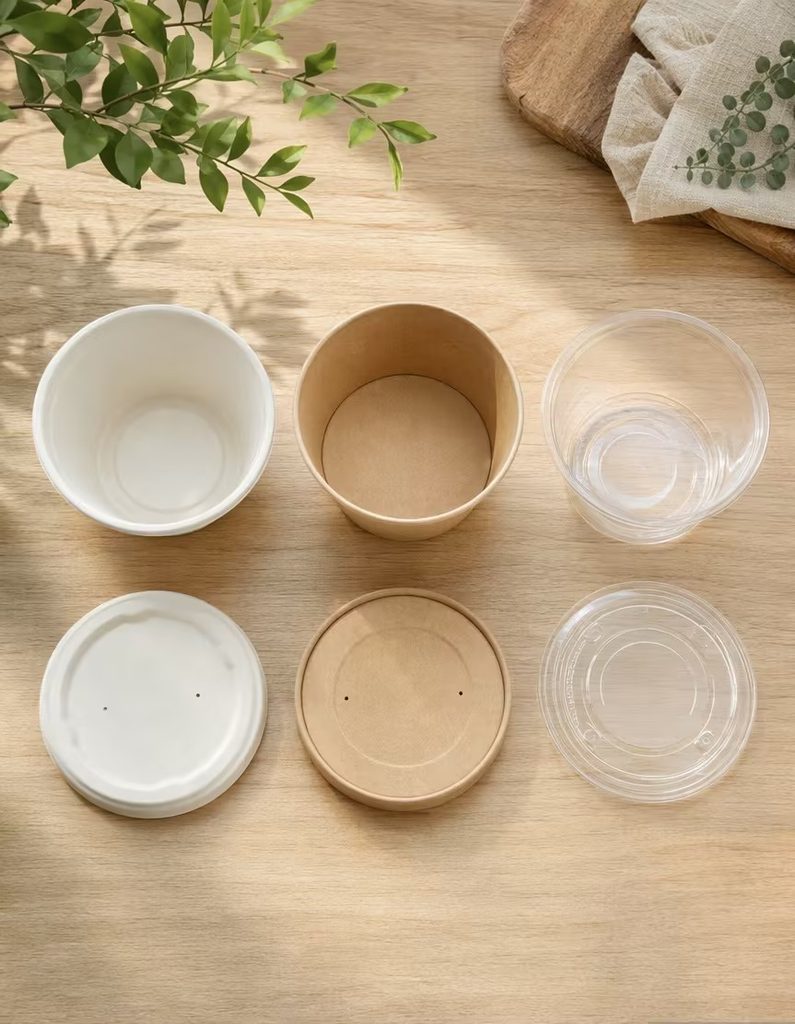
Four Materials, Four Different Failure Points
Sugarcane bagasse is the workhorse of molded fiber, but “workhorse” only holds when the factory controls moisture and forming parameters. Bagasse is the fiber left after sugarcane juice extraction. Its quality shifts with cane variety, harvest method and upstream processing. A serious factory manages moisture at intake and in storage, because once fiber moisture drifts, the finished bowl can mold or lose strength.
The number that matters is finished moisture content. Bagasse bowls below 8% moisture can go into a microwave. Bowls with higher moisture, or with metal-containing release agents, can arc. That is not a theoretical warning; it shows up in customer complaints. Bagasse also shrinks 2–3% after molding if curing is incomplete, which is where dimensional tolerance problems begin. A bowl that fits its lid perfectly in a sample and fails to snap in a bulk shipment is often not a mold problem. It is a curing curve and moisture-control problem.
Kraft paper bowls live or die on one detail: the liner. PLA liner means the finished bowl can be compostable. PE liner means it cannot. From the outside, the two look almost identical. Cheap paper bowls may carry a PE layer only 5 microns thick and fail a fifteen-minute leak test. A reliable paper bowl for a 500 ml format usually needs at least 250 gsm base paper and a 12–18 micron liner. The irony is painful: a buyer orders an “eco paper bowl,” receives paper plus plastic film, and ends up with something that belongs in neither compost nor recycling.
Clear PLA bowls deliver the best cold-display experience, but heat and oil are hard boundaries. A PLA-lined paper bowl holding hot oily curry can fail in about twenty minutes; bagasse under the same conditions can hold for an hour. PLA bowls themselves are no different. Buyers choose PLA for visibility, not heat performance.
Bamboo fiber is a smaller niche, usually paired with PLA liner in paper-bowl constructions. The logic is similar to bagasse, but the supplier pool is thinner and the certified finished-product scope deserves extra scrutiny.
The Menu Decides the Bowl’s Fate
A mid-sized delivery brand once ran bagasse bowls for curry brisket and kraft paper bowls for salads and yogurt. That split wasn’t arbitrary. When bagasse is heat-pressed to 3–4 mm thickness, its water vapor transmission rate can fall below 10 g per square meter per day, close to lined paper. Hot oil and broth need a physical barrier, not a chemical coating.
Paper bowls win on cold food and brand presentation. PLA-lined paper handles cold salads, fruit and desserts, and flexo printing, foil stamping and embossing give paper a surface quality bagasse cannot match. The trade-off: once hot soup or heavy oily food enters the menu, the liner specification has to move up, cost follows, and paper still isn’t the ideal vessel for hot oil.
Clear PLA is even narrower. Salad bars, dessert cases, cold yogurt and cut fruit are its comfort zone. Put hot food in a PLA bowl and the material savings return as leak complaints and refunds.
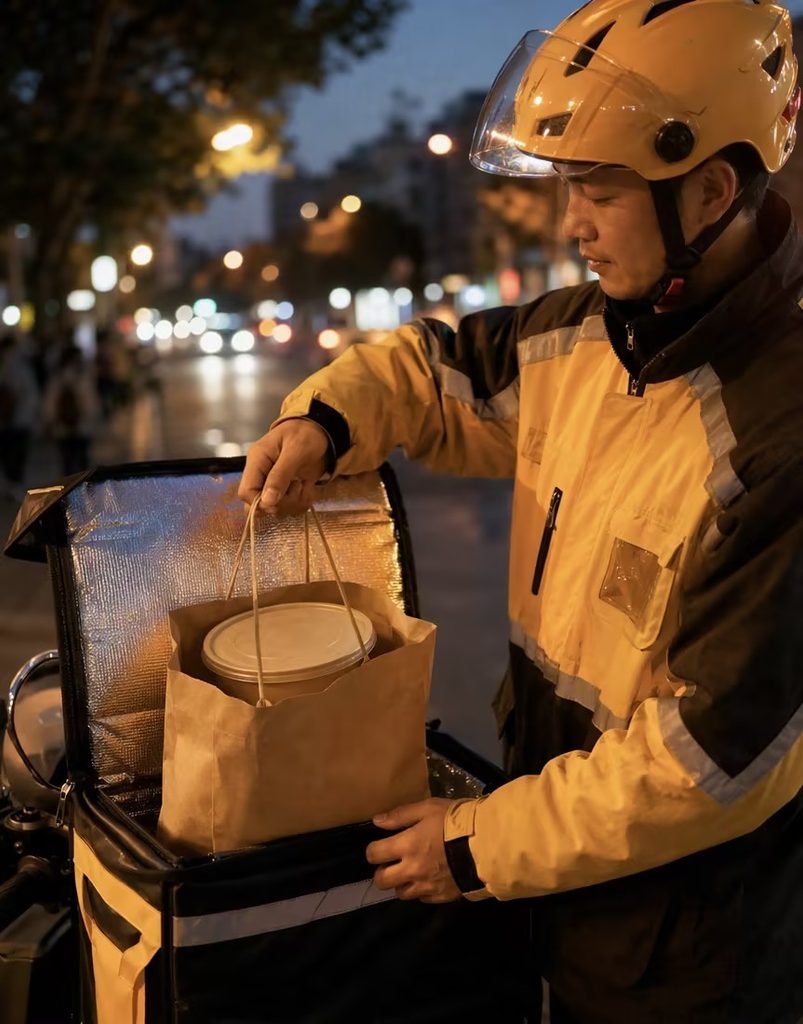
There is also an underestimated variable: lid fit. Bagasse bowls pair with fiber lids, paper bowls with paper or PLA lids, PLA bowls with matching clear lids. If bowl and lid come from two suppliers, a small difference in snap-fit force can open a delivery bag. A bowl’s leak resistance is never decided by the bowl alone.

Certification: One Certificate Cannot Save a Bowl
This is where information asymmetry runs deepest.
BPI is the North American benchmark. DIN CERTCO and TÜV Austria’s OK Compost are European baselines. But a BPI certificate on the table does not mean the bowl in front of you is certified. The certificate must name the finished SKU or a clearly defined product family. Three file gaps show up again and again: no product model listed, no material ratio stated, and a scope that covers raw material but not the finished article. Any one of those can stop a shipment at a retail compliance review or a regulator’s spot check.
PFAS is the quieter trap. Historically, many molded fiber foodservice products achieved oil and water resistance through intentionally added PFAS as a barrier agent. By 2026, California, New York, Washington, Maine and Minnesota have banned intentionally added PFAS in food packaging. BPI itself has added a total organic fluorine report below 100 ppm to its certification rules.
That means compostability certification and PFAS-free verification are two separate lines of evidence. A bowl can carry a BPI mark and still contain PFAS. A supplier saying “PFOA-free and PFOS-free” is not saying PFAS-free; it is naming two specific compounds within a much larger family. The purchase order needs a “PFAS-free attestation,” not a “PFOA/PFOS-free” statement.
Greenwashing litigation is tightening the space. The FTC’s 2025 civil penalty for a single substantive violation reached $53,088, and the agency has made clear that a supplier providing an unsupported “biodegradable certificate” downstream can itself be exposed to deception liability. A casually issued certificate travels up the supply chain as risk.
Three Buyer Scenarios That Actually Happen
Scenario one: a soup delivery brand swaps plastic for bagasse. The old plastic bowl was cheap, leak-free and familiar. The first month with bagasse brought complaints. The cause wasn’t the material. It was lid fit drifting across bulk production. The fix wasn’t a new material; it was accepting bowl and lid as one system. The test: 90°C water plus 5 ml vegetable oil, checked at 15, 30, 45 and 60 minutes, with no visible stain on white tissue at 30 minutes. Industry batches show why factory choice matters: one Chinese factory passed 48 of 50 batches, an Indian factory 45 of 50, a Vietnamese factory lower. Same material family, different factories, several percentage points of yield. “Bagasse bowl” is not a specification. The factory is.
Scenario two: a coffee chain’s salad line. The brand needs print quality and a cold-food focus. PLA-lined paper is the right answer, but the purchase order must lock liner type and grammage. A real lesson: a buyer saw a beautifully printed “compostable kraft paper bowl” at a trade show, ordered, and later found the liner was PE. The compostable claim collapsed. Switching to PLA meant new MOQs, new proofs and a new timeline.
Scenario three: a distributor building a private label. The goal is one bowl covering as many SKUs as possible. Bagasse handles that better because its heat and oil coverage is wider; there is no need to stock two material families for hot and cold. The cost is print expressiveness. Paper still wins on shelf presence.
MOQ, Lead Time and the Fine Print in the Quote
The standard MOQ logic: custom print usually starts at 5,000 units; 10,000+ brings flexo economics; digital short runs can start near 1,000 units at a higher unit cost; full OEM tooling runs 10,000–50,000 units. But the “5,000” on a quote needs one question: units or cartons? Bagasse bowls are light and bulky, so carton quantities vary widely. A carton-based MOQ and a unit-based MOQ can differ by several times.
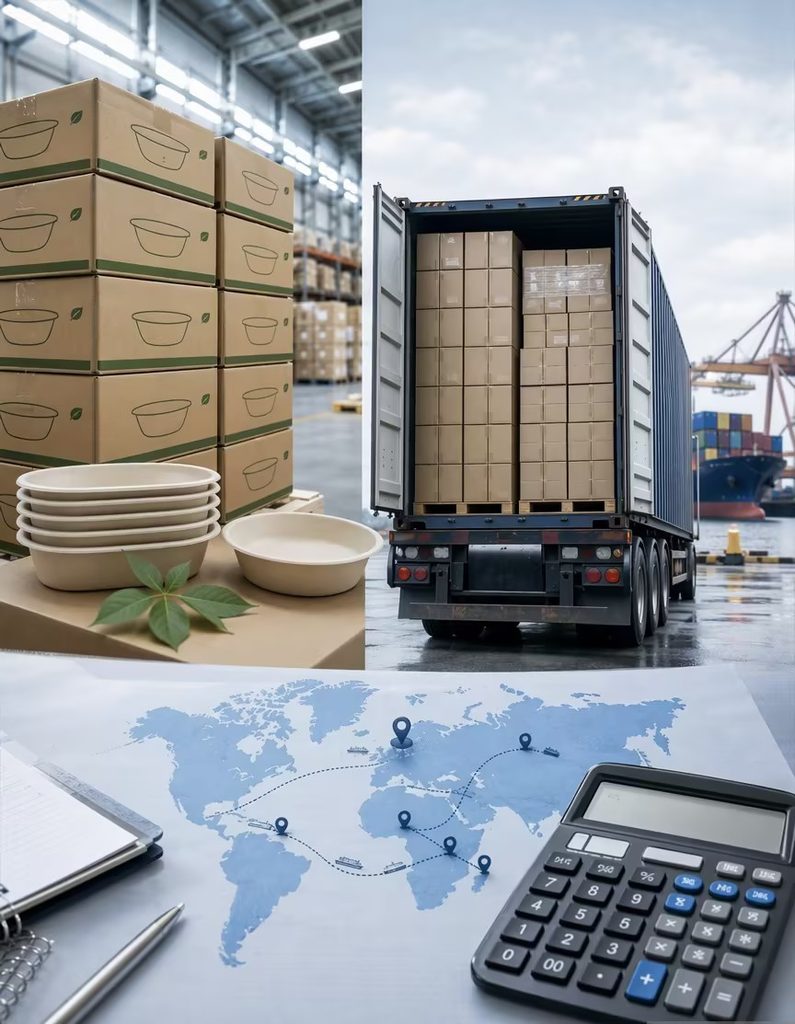
On lead time, production itself is often two to four weeks, with custom print adding proofing and plate-making. But ocean freight from China to the U.S. West Coast adds three to four weeks; the East Coast four to five. A “4–6 week delivery” quote that means “4–6 weeks ex-factory after artwork approval” can be ten weeks or more to warehouse. Suppliers doing custom printed paper bowls for the U.S. have quoted 13–19 weeks door-to-door from proof approval. If replenishment is planned on production time instead of door-to-door time, stockouts are almost inevitable.
A factory with twenty years of export experience will raise two more points. First, certificates must match the destination market: BPI and ASTM D6400/D6868 for the U.S., EN 13432 and DIN CERTCO for Europe, AS 4736 for Australia. ASTM D6400 and EN 13432 test conditions are not interchangeable; a bowl that passes one may fail the other’s disintegration timing. Second, containers are cubed out, not weighed out. Bagasse bowls are so light that a 40-foot container of one popular size may use less than half its payload. Mixed SKU loading is the most direct way to spread freight, but each SKU carries its own mold and MOQ. Every mixed SKU must clear its own minimum.
Comparison Table: Compostable Bowl Materials and Alternatives
| Attribute | Bagasse molded fiber | Kraft paper + PLA liner | Clear PLA | Conventional plastic (PP/PET) |
|---|---|---|---|---|
| Feedstock | Sugarcane by-product | Paper + corn-based PLA | Corn-based bioplastic | Fossil fuel |
| Compostable? | Yes, industrial (some home) | Yes, only if PLA-lined and finished product certified | Yes, industrial | No |
| Hot food / hot oil | Strong; hot soup holds 30+ minutes, better than lined paper under oil | Moderate; PLA liner can fail around 20 minutes with hot oil | Weak; not for hot food | Strong |
| Leak barrier | Fiber density; depends on forming | Liner thickness and integrity; PE or PLA decides fate | Material itself | Material itself |
| Print surface | Food-safe print, embossing; less refined than paper | Best; flexo, digital, foil, embossing | Limited; labels common | Labels common |
| Typical unit price (12 oz class) | About $0.20–$0.28 | About $0.15–$0.20 | Higher than PET equivalent | Lowest |
| Main sourcing risk | Moisture, curing, release agent, batch color | Liner type (PE vs PLA) and liner grammage | Heat limits, lid fit | Bans and compliance cost |
| Best use | Hot takeaway, soups, curries, rice bowls | Cold food, salads, branded print | Salad bars, desserts, cold display | Cost-first markets with no ban |
Those cost ranges come from 2026 public sourcing data; actual quotes move with MOQ, port and order structure. One trend is worth noting: at FCL volume, the unit-price gap between compostable packaging and virgin plastic has narrowed noticeably. Add UK and EU plastic-tax exposure, and full landed cost for some QSR categories is close to parity. On pure unit price, plastic is still cheaper. On total landed cost, the story changes.
Customization: What Can Be Branded, and What It Costs
Customization ranges from a one-color logo to a full structural and packaging program. The material constrains the method.
Paper bowls offer the widest decoration palette: flexo for volume, digital for short runs and seasonal artwork, CMYK and Pantone matching, matte or gloss lamination, hot foil, embossing, debossing and UV coating. Bagasse bowls take food-safe printing and embossing but are less suited to high-gloss finishes. PLA bowls usually take labels or stickers rather than direct print, though supplier capability varies.
The compostability-of-inks question deserves a formal RFQ line. A compostable bowl printed with petroleum-based inks is a greenwashing risk. Reputable suppliers now offer water-based and food-safe UV inks that are themselves compostable, and they can document ink chemistry alongside substrate certification.
Structural customization includes custom sizes, mold shapes, compartment layouts, lid formats and multilingual retail packaging. Private-label and OEM/ODM workflows usually start with vector artwork at print resolution, followed by a digital proof. Flexo runs may require a physical match-print proof before plates are committed.
FAQ
Is a compostable bowl the same as a biodegradable bowl? No. Compostable is a standard-tested claim tied to defined conditions and timelines. Biodegradable has no standardized timeframe or disposal environment, and an unqualified biodegradable claim is hard to defend in landfill conditions.
Can every bagasse bowl go in the microwave? No. Bagasse bowls below 8% moisture and free of metal-containing additives, including some release agents, can. Ask for a microwave test report. Do not assume bagasse equals heat-proof.
A paper bowl looks like paper. Why can’t it be recycled? The liner. PE liner makes it a poor fit for composting and hard to separate in most recycling systems. PLA liner solves the compostability question but still does not make it recyclable.
How do I verify a certificate actually covers my bowl? Three steps: does it name the finished model or product family; is the issuer BPI, DIN CERTCO, TÜV Austria or another verifiable body; can the certificate number be found in the issuer’s online directory. Thirty seconds of checking filters out most problem files.
Why is MOQ counted per SKU? Each size and shape has its own mold, and changing SKU means changing the mold and setup. Mixed-container loading is workable, but every SKU added must clear its own MOQ.
How long does custom print take to arrive? For the U.S., plan on ten weeks or more from production through ocean freight and customs. For custom printed paper bowls on slower sailings, suppliers have quoted 13–19 weeks door-to-door.
Conclusion
The hard part of buying a compostable bowl is not finding an “eco material.” It is turning an environmental claim into a chain of evidence that can be verified, written into a contract and checked on arrival. Material decides menu fit. Liner and coating decide whether the compostable claim survives. Certification decides the compliance floor. Moisture and curing parameters decide batch consistency. Lead-time definitions decide whether you run out of stock in peak season.
A reliable supplier will not dodge those questions. A factory with twenty years of export experience has seen too many buyers discover after artwork approval that the certificate does not cover the finished product, after the container lands that the liner is PE, and after the first delivery complaints that the lid came from another supplier. A good supplier asks about your destination market, menu temperature and packing-line speed, then locks the right specifications into the proforma invoice.
A compostable bowl is worth buying. It is worth a serious sourcing process, not just a green label. Ask every question above, and the bowl has a real chance of doing what it was promised to do—on the shelf, in the delivery bag and in the composting facility.