Insights & news
Compostable Paper Cups Buying Guide
Compostable Paper Cups: A Practical Buyer’s Guide
Most first-time buyers come to compostable paper cups with the same question: what’s the catch? Fair question. The category has matured a lot in the past five years, but it still comes with trade-offs that a friendly sales sheet won’t spell out. This guide covers the ones that actually affect your order — the lining, the certificate, the MOQ, and whether your city can even compost the thing.
What You’re Actually Buying
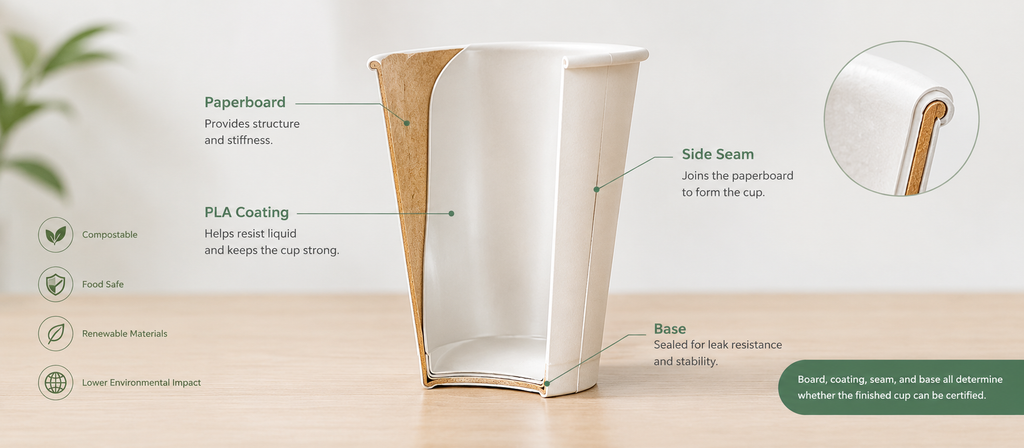
A compostable paper cup is not paper with a nice coating. It’s a finished assembly — board, lining, side seam, bottom seal, and the lid you pair with it. Every one of those parts affects whether the cup can legally carry a compostability claim.
That distinction trips up buyers constantly. We’ve had customers send over a resin datasheet from their coating supplier and assume the job is done. It isn’t. What you need is certification on the finished cup model. Ask for the certificate number. If the supplier hesitates, keep shopping.
The market itself has moved fast. Compostable paper cups were around US$680 million globally in 2025, heading toward roughly US$925 million by 2032. That growth isn’t coming from consumer sentiment alone. It’s coming from procurement rules — zero-waste tenders, plastic-lined cup levies in parts of Europe, PFAS restrictions tightening on food-contact packaging. Buyers aren’t choosing these cups because they’re lovely. They’re choosing them because a PE cup no longer clears the bid.
The Lining Decides Everything
Three lining routes dominate commercial supply, and they behave very differently.
PLA is the workhorse. Plant starch — corn or sugarcane, usually — turned into a film that looks and feels like PE. It’s certified industrially compostable to EN 13432 in Europe or ASTM D6400 in the US. Coating weights typically land between 18 and 30 g/m². Go below 18 and the water vapour transmission rate starts to bite you on hot drinks.
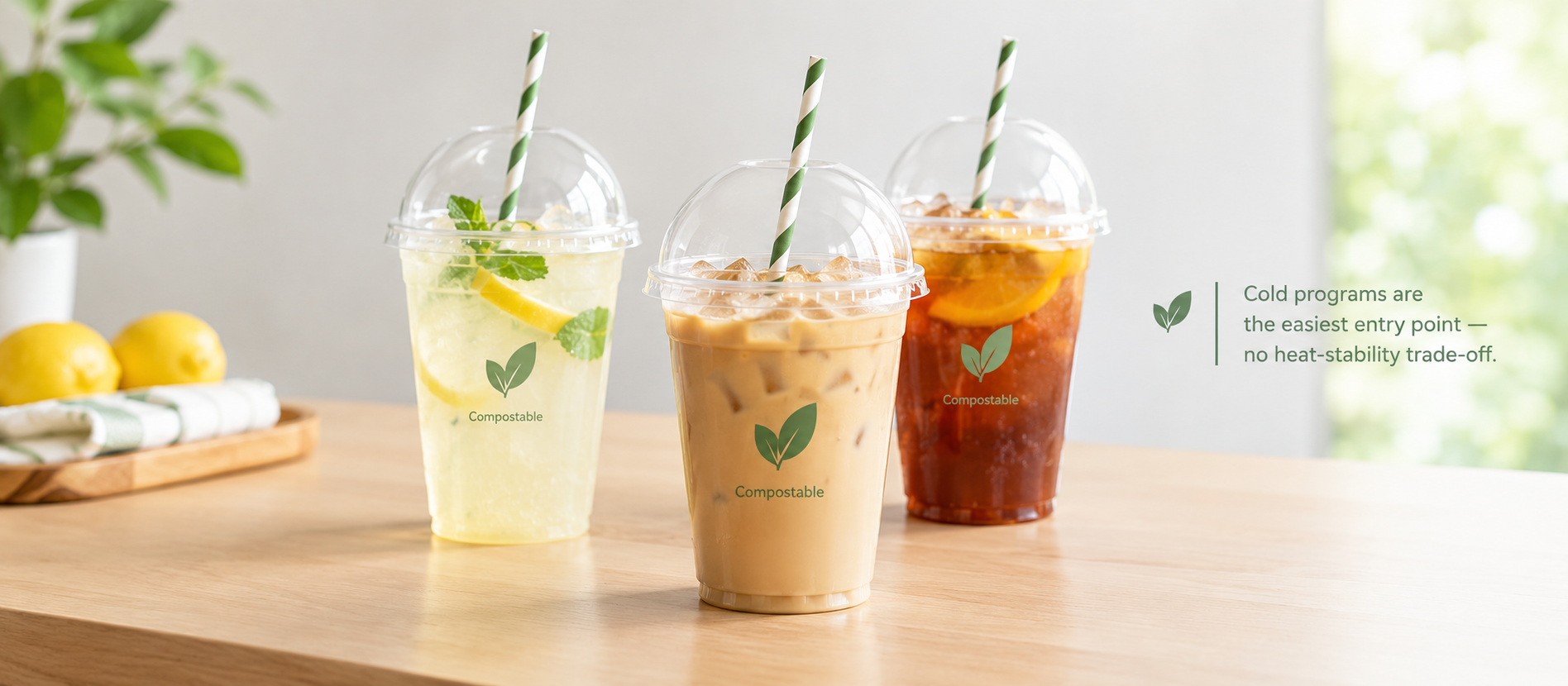
Here’s the PLA catch nobody mentions in the brochure: standard PLA softens above about 55°C. For cold cups — iced coffee, cold brew, fountain drinks — it’s a straight swap with no drama. For hot programs you need a heat-stabilized construction and CPLA lids, and you need the supplier to confirm it in writing rather than nod along.
Water-based coatings drop the plastic film entirely. A bio-based dispersion handles water, oil, and heat without intentionally added PFAS. Plenty of European buyers now prefer this route because the cup stays repulpable in fiber streams where facilities accept it — compostability becomes an option rather than an obligation.
PHA is the newest and priciest. Some PHA-lined configurations have earned home-compostability certification, which extends the end-of-life story beyond industrial facilities. Volumes are still small. But it tells you where this is heading: multi-pathway compostability instead of one PLA standard for everything.
Substrate matters too. Virgin food-grade board is the default. Bamboo, sugarcane bagasse, and FSC-certified pulp are available for brands that need a differentiation story. Just remember — compostable film on uncertified board gives you an uncertified cup.
Where They Actually Earn Their Keep
Compostable paper cups make the most sense where collection already exists. A café with back-of-house organics pickup can toss cups and coffee grounds in the same bin — and tell customers about it without stretching the truth. That front-of-counter flow, from 8 oz flat whites to 16 oz takeaway, is where most successful switches start.
The second sweet spot is institutional. Universities, corporate campuses, and stadiums writing zero-waste clauses into tenders increasingly require certified compostable serviceware as a pass/fail condition. In those bids, unit price is almost secondary — you either have the certificate or you’re out. And because a cup without a matching compostable lid is just a leak waiting to happen, the lid has to be specified in the same conversation.
A real scenario worth picturing: a 12-store regional coffee chain wants to switch. Cold drinks are easy — PLA-lined cold cups drop straight into the existing workflow. Hot drinks need a heat-stabilized spec and a lid change. The chain usually ends up running a mixed pallet first, and that’s fine. Just specify compostable lids and hot cup formats in the same order, or you’ll spend a week chasing fit problems.
The Honest Case For and Against
What compostable paper cups really buy you is access. Access to tenders that exclude PE. Access to markets with per-cup levies on plastic-lined packaging. Access to a brand story that doesn’t collapse under scrutiny when a customer turns the cup over.
Cost is real, though. Expect roughly 8% to 15% more per unit than PE. In levy markets that gap often closes or flips in your favour. In markets with no levy and no composting infrastructure, you’re paying a premium for a claim you can’t fully deliver on.
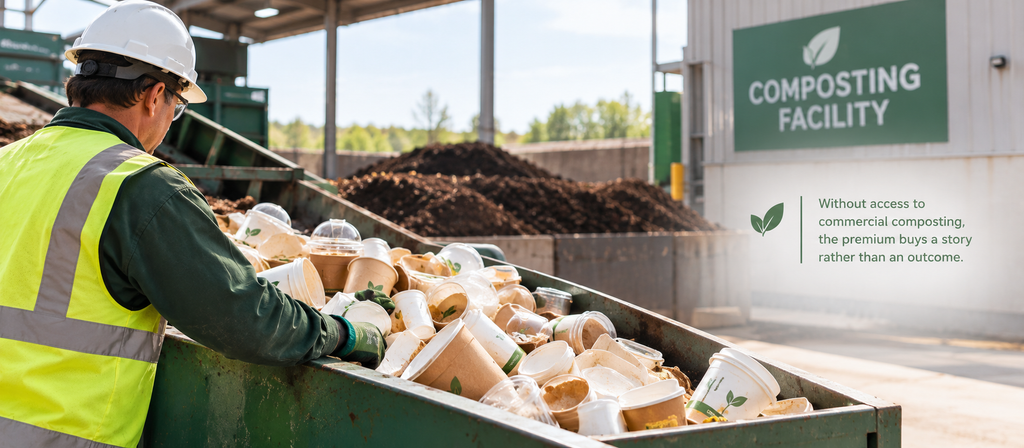
That’s the limitation nobody likes saying out loud. A certified cup only composts if it reaches a commercial facility. Ship it to a city with no organics collection and it lands in landfill next to the PE cup it replaced. Life-cycle studies also push back on the assumption that composting always wins — recycling and reuse outperform single-use compostable cups in some scenarios. Be honest about your disposal pathway. Buyers who overclaim get found out, usually by a journalist.
Printing, Customization, and What Not to Do
Printing follows the same toolkit as conventional cups — flexo, offset, digital. Soy-based inks are standard. Exterior-only printing is the norm on compostable lines.
Flexo is the sensible choice for high-volume one or two-colour logos. Offset gets you photographic detail and gradients for premium branding. Digital handles short runs and versioned campaigns without plate costs.
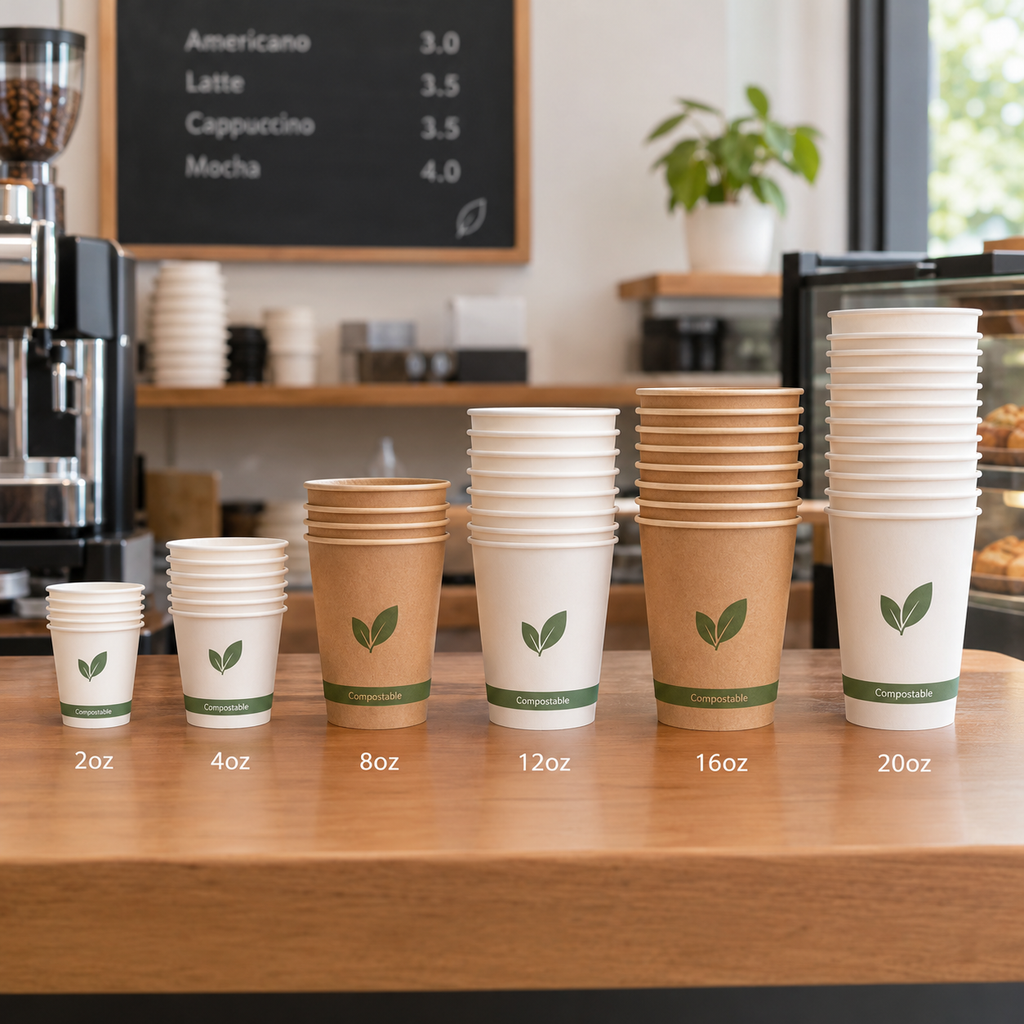
Sizes run 2 oz to 20 oz. Single-wall, double-wall, ripple-wall. Kraft or white board. CPLA lids and sip lids. Hot-stamping and matte or gloss finishes exist on double-wall formats — but here’s where buyers get themselves into trouble. Metallic foil usually disqualifies a cup from a compostability claim unless the supplier has verified a compliant alternative. Decide the coating and certification first, then pick the finish within those limits. Get that order wrong and you’ll be reprinting.
MOQ, Lead Times, and Factory Reality
MOQs vary more than most buyers expect. Stock PE cups sometimes start at 20,000 per size. PLA compostable cold cups usually sit around 30,000 per size for custom work. Chinese export suppliers quote anywhere from 5,000 pieces on select stock PLA items to 50,000–100,000 per design for fully custom printed runs.
At Tonchant Earth’s factory, the number that actually matters isn’t the headline MOQ — it’s whether your order shares a coating line with something else. A custom design on a standard 12 oz PLA cold cup is straightforward. A custom design with a bespoke board weight, unusual coating, and five-colour offset is a different project entirely, and it will move your minimum up.
Lead times follow the same logic. Stock samples ship in about a week. Custom printed samples take 7–10 days with a sampling fee in the US$100 range depending on complexity. Mass production runs 20–30 days after deposit and artwork approval, with 25–30 days being the realistic window. Add three to five weeks of ocean freight and a custom program from brief to warehouse is 8–12 weeks. Plan your launch around that, not around the best-case quote.
One sourcing note from the floor: coating weight is where quality quietly varies between factories. We’ve seen incoming shipments from other suppliers spec’d at 18 g/m² arrive closer to 15, and the cups leak at the seam before the pallet is half used. Ask for the coating weight in writing, then check it against a sample batch. It’s a five-minute test that saves a customer complaint.
Certificates Worth Asking For
Skip the “eco-friendly” badge on the listing page. Ask for third-party certification on the finished assembly.
The two standards that matter are EN 13432 in Europe and ASTM D6400 in the US. EN 13432 requires 90% fragmentation through a 2 mm sieve within 12 weeks and 90% organic carbon conversion within six months under industrial conditions. ASTM D6400 uses a 60-day biodegradation window under ASTM D5338. They’re similar in intent and not interchangeable — an ASTM-only certificate doesn’t make a cup EN 13432-compliant in the EU without separate testing. For coated paper specifically, ASTM D6868 is the relevant US specification.
BPI administers the ASTM logo program in the US. DIN CERTCO issues EN 13432 registrations in Europe, and TÜV Austria’s OK Compost is another recognised mark. Verify the number in the public registry yourself. Check the scope covers your cup model, not just the resin, and check the validity date.
Then ask two more questions: food-contact compliance for your market, and a PFAS-free declaration. Both EN 13432 and ASTM D6400 cap total fluorine at 100 ppm, and the EU has applied PFAS limits to food-contact packaging from August 2026. A supplier who can’t produce a finished-cup certificate and a fluorine declaration isn’t a compliant supplier of compostable paper cups — whatever the resin datasheet says.
FAQ
Are compostable paper cups recyclable?
Usually not in municipal paper streams. The coating isn’t designed to separate, so the cup belongs in commercial composting. Aqueous-coated versions may be repulpable at some facilities, but confirm it with the mill before you print a recycling claim.
Will they go soft with hot drinks?
PLA cups hold up fine for hot beverages when the supplier specifies a heat-stabilized construction — standard PLA softens around 55°C, so get the coating weight and lid material confirmed in writing. Double-wall and ripple-wall add rigidity. Aqueous and PHA coatings are formulated for hot and cold barrier performance.
What MOQ should I expect for custom printing?
Around 30,000 pieces per size for PLA-lined cups is typical, with full custom print runs from Chinese suppliers often quoting 50,000–100,000 per design. Stock 8–16 oz sizes may be available lower. Always ask whether the MOQ applies per size, per design, or per coating line — the answer changes the maths.
Are they home-compostable?
Mostly no. EN 13432 and ASTM D6400 are industrial standards, not backyard ones. A handful of PHA-lined products carry home-compostability certification, but treat that as a product-specific claim requiring a certificate, not a category-wide assumption.
How do I check a supplier’s certificate is genuine?
Get the certificate number and certifying body, then look it up in BPI’s product listing or DIN CERTCO’s registration database. Confirm the scope covers the finished cup and the date is current. A legitimate supplier hands this over without being asked twice.
The Short Version
Buying compostable paper cups is a specification job before it’s a sustainability statement. Certify the finished assembly to the standard your market recognises. Pair it with a collection pathway that can actually process it. Then build the order around MOQ, lead time, and your launch date — in that order, not the reverse.
PLA remains the most mature route. Aqueous coatings are gaining ground fast. PHA is the premium option for home-compostability claims. The 8–15% premium over PE is real, but in levy markets and institutional tenders it’s less an upgrade than the cost of staying eligible. Get the certificate first, check the coating weight on arrival, and be honest about where the cup ends up. That’s what separates a working packaging decision from a line on a website.