Insights & news
Eco-Friendly Packaging for Coffee Chains: A Buyer’s Guide
A paper cup looks innocent from behind the counter. From the procurement side, it is a pile of trade-offs stacked in a cardboard sleeve. Heat resistance versus compostability. Cost versus compliance. Brand presentation versus what actually happens when that cup leaves the store and rides around in a courier bag for twenty minutes.
The pressure is no longer theoretical. The EU Packaging and Packaging Waste Regulation applies from August 12, 2026, and it does not ask politely—non-compliant coffee packaging gets stopped at customs, and retailers face fines up to 5% of turnover. California’s SB 54 now requires independent certification behind any “compostable” claim. PFAS testing happens on the finished product, not the raw material. A coffee chain specifying packaging today is specifying for rules already in force, not rules that might arrive someday.
This guide walks through the coffee packaging categories that actually matter for a chain—cups, lids, sleeves, carriers and the closures around them—and the sourcing details that decide whether an eco-friendly switch holds up across fifty stores or falls apart in the first delivery bag.
Product Overview
Eco-friendly coffee packaging for a chain is not one product. It is a system: hot cups, cold cups, lids, sleeves, carriers, stirrers, straws and takeaway bags. Each piece has a different job. The weakest link decides whether the whole package works.
Hot cups dominate the conversation because they face the hardest conditions. Brewed coffee hits the cup at 195–205°F and is served at 160–180°F. A material that looks fine on a shelf can delaminate, warp or leave an off-flavor under that load. Cold cups face the opposite problem—condensation, clarity, crack resistance—and a hot-cup solution is almost never the right cold-cup solution.
Lids are the quiet failure point. A lid that does not seal reliably turns every delivery order into a complaint. A lid that softens under heat turns a hot latte into a lap full of coffee. Sleeves and carriers are lower-risk, but they still carry brand and insulation duties—and they are often the smartest place to start a sustainable transition, because the performance bar is lower.
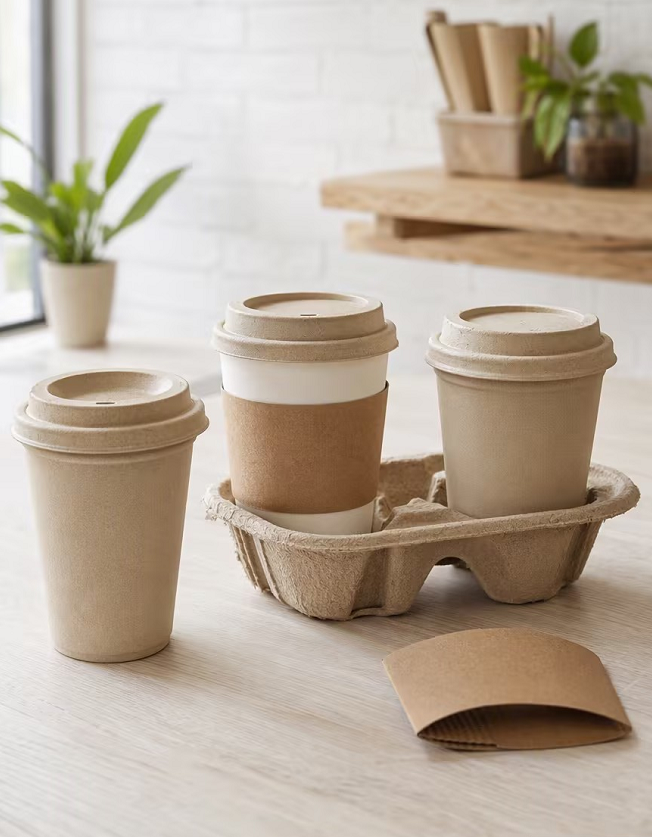
The material split runs three ways: paperboard cups with a barrier coating (water-based, PHA or PLA), molded fiber cups and lids made from bagasse, and bioplastic lids (PLA or CPLA) paired with a fiber cup body. Each has a place. The mistake is treating them as interchangeable.
Materials
The material conversation in coffee packaging starts with heat, because coffee is unforgiving.
Bagasse—sugarcane fiber—is the strongest performer on heat. Molded fiber cups and lids handle continuous temperatures around 120°C (248°F), and suppliers report boiling-water tests with no softening or leakage after 30 minutes. The fiber is already “cooked” during pulping, so the finished product does not deform the way thermoplastic does. Bagasse lids are rated up to 220°F, which covers the hot-coffee range with real margin.
PLA is the material that gets specified too often for the wrong job. Standard PLA softens around 60°C (140°F). A standard PLA lid can warp under a hot latte within minutes. CPLA—crystallized PLA—raises that ceiling to roughly 85°C (185°F). Workable for hot drinks. Still short of boiling water. Noticeably more brittle than fiber. Where PLA earns its place is cold cups and clear lids, where visibility and cost matter more than heat.
Paperboard with a barrier coating is the volume play. The coating is the whole game. A conventional PE lining makes the cup effectively unrecyclable in most systems because the plastic and paper cannot be separated economically. Water-based and PHA aqueous coatings replace that lining with a barrier that keeps the fiber in a single recycling or composting stream. One tested structure—280gsm paperboard plus 12g PHA aqueous coating with a bagasse pulp lid—held 100°C water for 15 and 30 minutes with no observed leakage. No PE. No PLA. No conventional plastic lining.
Then there is PFAS, the material decision that can invalidate everything else. These chemicals were historically used to make fiber packaging repel oil and water, and they are incompatible with a genuine compostability claim because PFAS contamination undermines the end-of-life story. PFAS-free formulations are now standard among serious suppliers. “Standard” is not “universal,” though, and the burden of proof sits with the buyer.

Applications
Hot cups are the core application. The specification question is not “which eco cup” but “which eco cup for this serve size and this dwell time.” A 12oz flat white consumed in three minutes is a different packaging problem from a 20oz latte that rides in a delivery bag for twenty minutes. Molded fiber and aqueous-coated paperboard both handle the short-dwell case well. Longer dwell times and larger volumes put more stress on the lid and the seam than on the cup wall.
Cold cups and clear lids are where PLA still makes sense. Iced coffee, cold brew and blended drinks do not stress the heat ceiling, and clarity supports the product. The trap is assuming a cold-cup lid can double as a hot-cup lid. It cannot.
Sleeves and carriers are the low-risk entry point for a chain testing eco packaging. Molded pulp carriers provide thermal insulation and anti-slip performance, resist breakage, and fit snugly around cup bases to reduce slippage—useful for two-cup and four-cup takeaway orders. They are also highly visible to the customer, which makes them a useful branding surface. For a chain that wants to dip a toe in before committing the whole cup line, this is where to start.
The application where eco coffee packaging most often fails is the one nobody specs carefully: the delivery order. A cup that performs at the counter can leak at the seam after ten minutes in a tilted bag. A fiber lid that seals cleanly on a dry rim can soften if coffee splashes into the closure. Chains running a delivery-heavy mix should test the full assembly—cup, lid, carrier and bag—under the same tilt and vibration the courier will produce. Not just at the pass. In the bag.

Advantages
The first advantage is regulatory readiness. A coffee chain that switches to PFAS-free, certified compostable or fiber-recyclable packaging now is not scrambling when the next rule lands. The EU PPWR is directly enforceable across all 27 member states without national transposition. One non-compliant SKU can be stopped at any border. Compliance is cheaper as a design input than as a retroactive fix.
The second is heat performance. Bagasse’s 120°C ceiling gives a chain real margin on hot drinks, and it removes the lid-warp failure mode that plagues standard PLA. That margin matters more in delivery than at the counter, because delivery holding times are longer and less controlled.
The third is the customer-facing signal. A molded fiber lid or an unbleached fiber carrier reads as deliberate. For chains selling into offices, campuses and environmentally engaged demographics, that signal has commercial value beyond the packaging line.
The costs are real and should be budgeted honestly. An 8oz hot cup in conventional plastic runs roughly $0.06–$0.09 per unit. A compostable alternative runs $0.08–$0.14, a premium of about 25–45%. Compostable fiber lids carry a 30–60% premium over conventional plastic lids at standard wholesale volumes. At the chain level, packaging is 4–5% of operating cost, and a full non-plastic switch can add roughly 1% to that ratio in the short term. The green premium has narrowed compared with five years ago. It has not disappeared.
There is also a storage and logistics cost that rarely appears in the unit-price comparison. Fiber cups and lids are bulkier than their plastic equivalents. A chain with tight back-of-house storage will feel that before it feels the per-unit premium.
Customization
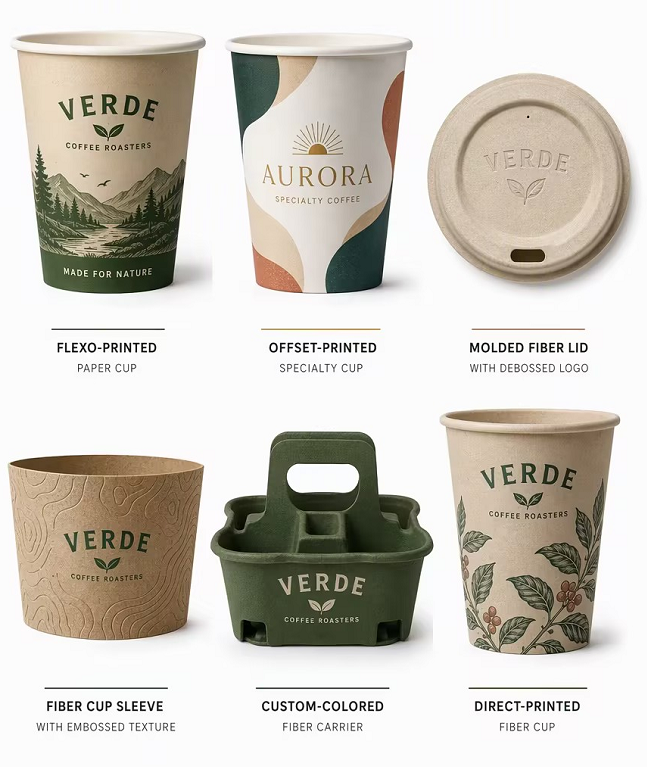
Coffee chain customization usually centers on the cup and the sleeve, because those are the surfaces the customer holds. Flexographic printing is the workhorse for high-volume paper cups—low unit cost, high setup volume. Offset printing delivers finer gradients for specialty coffee brands willing to pay a higher plate and minimum. Direct printing on formed fiber cups and lids is growing because it turns the container itself into the brand surface, though printability on molded fiber is less smooth than on paperboard.
Embossing and debossing work well on fiber lids and sleeves because they add a tactile brand cue without ink. Foil stamping and spot UV look premium but can interfere with compostability or repulping. The design rule for eco coffee packaging is that every component should travel the same end-of-life path.
The customization decision that separates a smooth rollout from a painful one is the cup-lid fit. A custom-printed lid that seals inconsistently on the production cup is a quality problem disguised as a branding project. Specify the lid and cup as a matched pair. Test the fit on the actual production tooling. Do not approve artwork until the closure passes a tilt-and-hold test.
MOQ
MOQ in coffee packaging is driven by the printing process and the tooling more than by the material. Digital printing on coffee bags can start as low as 500 pieces. Gravure or flexo runs on cups and sleeves commonly require 50,000 pieces for plain stock and 100,000 for printed stock at some suppliers. The spread is enormous, which is why a chain should never accept a single MOQ number without knowing which process it refers to.
Molded fiber cups and lids sit in a different band. Tooling exists for standard sizes, and MOQ is often quoted per SKU in the thousands rather than tens of thousands. Custom shapes, custom compartment carriers or bespoke lid profiles push the floor up because a new mold has to be amortized.
The practical sourcing play for a chain is to separate the “hero” SKU from the long tail. Put the custom-printed hot cup on a high-volume run where setup cost disappears into the unit price. Keep seasonal or limited-edition designs on digital or lower-volume processes. Stock fiber lids and carriers can carry the base program while the cup does the branding work. That mix usually produces a lower blended cost than forcing every SKU through the same high-MOQ process.
Lead Time
Samples for standard coffee packaging typically run 5–7 days. Mass production of stock items commonly lands in 10–15 working days. Custom-printed or custom-tooled programs more often run 18–28 days. Some suppliers quote around 30 days for OEM/ODM coffee packaging programs.
What stretches a timeline? Custom tooling fabrication. Artwork approval cycles. Chinese New Year and holiday shutdowns. Inland transit to port. A factory that quotes “25 days” without saying whether the clock starts at deposit, at artwork sign-off or at sample approval is giving you a number, not a schedule.
For a chain rolling out across multiple markets, the bigger risk is not the production window. It is discovering after the first shipment that the lid fit is wrong on the production cup. Build a validation stop between tooling and mass production. Treat the sample lead time as the cheap part of the timeline.
Certificates
Coffee packaging certification has two separate jobs: proving the material is safe for food contact, and proving the end-of-life claim is real. A supplier can be strong on one and weak on the other.
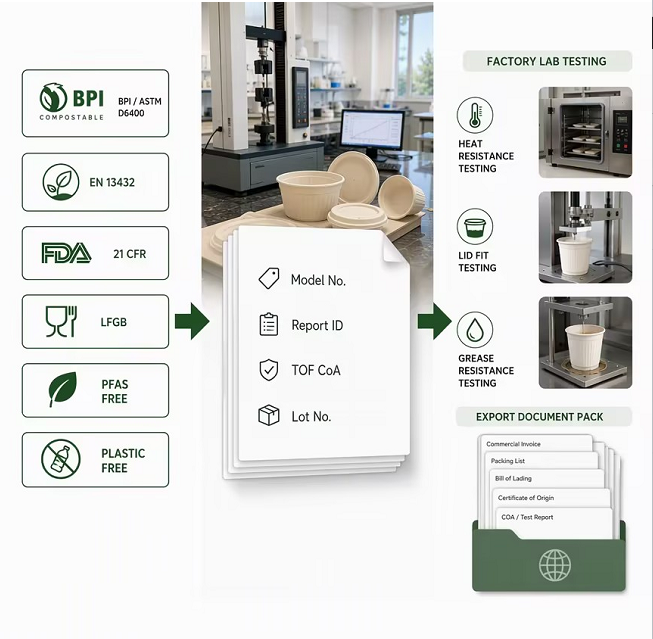
For compostability, the schemes buyers ask for most are EN 13432 in Europe and ASTM D6400/BPI in North America. BPI certification has become the practical gatekeeper in California, where SB 54 requires independent certification behind a compostable claim and uncertified claims are now illegal. Home-compostability certifications such as NF T51-800 and AS 5810 matter in markets where curbside industrial composting is unavailable. Australia now requires the AS 5810 mark on each individual item, not just the carton.
For food-contact safety, FDA compliance is the baseline for the U.S., and LFGB is the strictest EU standard. EU 1935/2004 and FDA 21 CFR sit alongside those depending on destination. Standard bagasse cup and lid lines frequently carry FDA 21 CFR 176.170, BPI/ASTM D6400 and EN 13432 documentation as a baseline set.
PFAS documentation deserves its own paragraph because it is where “PFAS-free” claims most often fall apart. US state bans generally prohibit intentionally added PFAS. The EU PPWR and California set numeric limits that require a lab result. A signed supplier declaration alone does not prove EU or California compliance. A lab report alone does not prove US state compliance. The buyer needs the document that matches the law being satisfied. For California and the EU, that means a Certificate of Analysis from an ISO/IEC 17025-accredited lab showing total organic fluorine (TOF) below 100 ppm on the finished product. Keep declarations and CoAs on file for at least five years. Several state laws attach penalties for false certifications, and documentation requests can arrive long after the purchase.
FAQ
Can a compostable coffee cup actually hold hot coffee? Yes, if the material matches the job. Bagasse handles continuous temperatures around 120°C and has passed boiling-water tests. Standard PLA does not—it softens near 60°C. The material name on the box matters less than the heat rating on the spec sheet.
Are eco coffee cup lids leak-proof? A fiber lid can seal reliably, but the fit is cup-specific. Test the lid on the production cup under tilt, not just on a sample bench. Fiber lids can soften if coffee is held against the closure for extended periods.
Do I need BPI certification for California? If you make a compostable claim, yes. SB 54 requires independent certification behind the claim, and uncertified “compostable” language is now illegal in the state.
What does PFAS-free actually require? A supplier declaration for US state laws that prohibit intentionally added PFAS, plus a Certificate of Analysis from an accredited lab showing TOF or targeted PFAS below the applicable numeric limit for the EU or California. One does not substitute for the other.
What MOQ should a coffee chain expect? It depends on the process. Digital printing can start at hundreds of pieces. Flexo or gravure on cups and sleeves commonly requires tens of thousands. Molded fiber stock lids and carriers are usually lower. Split the program by SKU rather than forcing one MOQ across the whole range.
How much more does eco coffee packaging cost? An 8oz hot cup runs roughly 25–45% above conventional plastic, and fiber lids carry a 30–60% premium over plastic lids. The green premium has narrowed but has not closed.
Can I get custom branding on fiber lids and cups? Yes—flexo, offset, direct print, embossing and debossing are all available. Embossing works particularly well on fiber because it avoids ink while adding a tactile cue.
Comparison Table
| Factor | Bagasse Fiber Cup + Lid | Paperboard + Aqueous/PHA Coating | PLA / CPLA Lid + Paper Cup | PE-Lined Paper Cup (Conventional) |
|---|---|---|---|---|
| Heat tolerance | High; continuous ~120°C, boiling-water tested | Moderate to high; coating-dependent, PHA structure tested at 100°C | Standard PLA ~60°C; CPLA ~85°C | Moderate; liner can separate under prolonged heat |
| Lid performance | Fiber lid rated to ~220°F; fit must be tested per cup | Fiber or CPLA lid; closure dependent on rim match | CPLA workable for hot; standard PLA for cold only | PP lid performs well but is not compostable |
| Compostability | Industrial and home options available | Compostable or recyclable depending on coating | Industrial compost only (PLA); CPLA similar | Not compostable; liner complicates recycling |
| Recyclability | Primarily compost route | Fiber recyclable if coating compatible | PLA can contaminate paper recycling | Difficult; plastic-paper separation required |
| PFAS risk | Must be verified SKU-by-SKU | Must be verified; aqueous coatings are a PFAS-free route | Lower fiber-PFAS risk, but lid additives need review | Historical PFAS use in some fiber cups |
| Cost position (8oz hot cup) | Moderate to high | Moderate; ~10–25% above PE-lined at volume | Moderate; CPLA adds ~30% over PLA | Lowest baseline |
| Best fit | Hot drinks, delivery, eco-led branding | High-volume hot cups, recycling-friendly programs | Cold cups, clear lids, short-dwell hot serves | Transitional volume where compliance allows |
Bagasse wins on heat and end-of-life honesty. Aqueous-coated paperboard wins on volume economics and recycling compatibility. PLA wins on clarity and cold-cup cost. PE-lined paper remains the cheap baseline, and it is the option most exposed to the next round of regulation.
Sourcing Considerations and a Factory Reality Check
Market direction is not in doubt. Hot drinks packaging is forecast to grow from roughly $16.6 billion in 2026 to $25.1 billion by 2035. The biodegradable/compostable segment within it is tracking toward $3.26 billion at a 9.1% CAGR—faster than the category as a whole. Coffee is the dominant product segment in hot drinks packaging, which means coffee chains are not a niche buyer group. They are the volume that determines which material lines scale.
The sourcing question is not whether suppliers can make eco coffee packaging. It is whether a given factory can make the cup-lid-carrier system work together, document the compliance chain, and still be there on the second order. That is where factory-level experience earns its place.
Tonchant Earth has been in packaging since 2005 and moved into compostable and biodegradable coffee, tea and food packaging around 2015. Its line includes bagasse and unbleached kraft paper cups, compostable lids in flat and dome profiles, high-adhesion cardboard sleeves, and FSC-certified wooden stirrers. The workshop runs 11,000 square meters with SC, ISO 22000 and ISO 14001 certifications. Compostability credentials include TÜV Austria, DIN CERTCO, BPI and ABA, with product-level registrations traceable to specific models. Export coverage spans 82+ countries, which matters for a chain sourcing across multiple markets with different certification requirements.
Here is how the sourcing gap shows up in practice. A regional coffee chain with 40 stores switches its 12oz hot cup from PE-lined paper to a fiber cup with a fiber lid. The first shipment looks right at the counter. Three weeks in, the delivery orders start generating complaints—not leaks at the cup seam, but lids that feel loose after the cup has been tilted in a bag for fifteen minutes. The root cause is not the material. The lid was specified against a nominal cup diameter rather than the production cup’s actual rim, and the fiber lid’s moisture uptake changed the fit under steam. A factory with an in-house lab and a lid-fit protocol catches that before mass production. A trading company with a catalog does not.
Second scenario. A chain wants a PFAS-free hot cup for the EU market. The supplier sends a signed declaration, which satisfies the US state law inquiry the chain also has. But the EU requires a numeric limit and a Certificate of Analysis, and the declaration does not contain a TOF result. The chain ships. The container is held at customs. The “cheap” cup becomes the most expensive packaging decision of the year. The fix is procedural: require the CoA before the PO, not after the first shipment.
A few habits separate smooth coffee packaging programs from painful ones. Specify the cup, lid and carrier as a matched system and test the assembly under delivery conditions. Confirm whether MOQ is per SKU or per process, and whether stock fiber lids can carry the base volume while the printed cup carries the brand. Ask for the PFAS document that matches the destination market, not the document that is easiest to send. And plan storage by volume, not unit count—fiber cups and lids take more shelf space than the plastic they replace.
Conclusion
Eco-friendly coffee packaging is no longer a brand gesture bolted onto a chain’s operations. It is a compliance requirement, a heat-performance decision and a delivery-reliability question, all sitting on the same purchase order.
The buyers who get it right start with the serve, not the catalog. They match the material to the heat and dwell time, specify the closure as a system, and test the assembly the way a courier will treat it. They ask for the certification that matches the market they are selling into—BPI for California, EN 13432 for Europe, a TOF CoA for any PFAS-free claim—and they keep the paperwork longer than the marketing team keeps the launch deck. They split MOQ across processes instead of forcing every SKU through the same high-volume run. And they treat factory lab capability as a sourcing criterion, not a brochure detail.
For a coffee chain, the practical answer is rarely one material. It is a mixed program: fiber for the hot cup and lid where heat and compostability matter most, aqueous-coated paperboard where recycling infrastructure and volume economics favor fiber recovery, CPLA where clarity and cold service justify the trade-off. Get the system right, and the coffee packaging does its job quietly—holds the heat, seals the lid, survives the bag, and ends its life in the stream you told the customer it would.