

How Compostable Food Packaging Is Made: From Plant Fiber to Finished Product
Introduction
The shift toward compostable food packaging is changing how restaurants, food delivery companies, distributors and packaging importers evaluate disposable packaging.
What looks like a simple molded-fiber plate or takeaway box on the customer side is actually the result of several industrial processes: raw-material preparation, pulping or polymer processing, forming, drying, trimming, quality control and, increasingly, certification and supply-chain documentation.
At the same time, the market is becoming more complicated. Buyers are no longer asking only whether a product is "biodegradable" or "eco-friendly." They increasingly want to know what it is made from, where it can be composted, which standards it meets, how it performs with food and whether the sustainability claim can be verified.
This is particularly important as regulations evolve in Europe, North America and Asia. Packaging companies are having to balance environmental targets with food safety, cost, production capacity and practical waste-management infrastructure.
Understanding how compostable packaging is actually manufactured gives B2B buyers a better basis for comparing suppliers and avoiding misleading sustainability claims.
Industry Background
Compostable food packaging is not a single material category. It includes products manufactured from different renewable or biodegradable feedstocks and through different production technologies.
Common material groups include:
Sugarcane bagasse
Bamboo fiber
Wood pulp and molded fiber
PLA
Paper and paperboard with suitable compostable coatings
Starch-based materials
Other certified biodegradable or compostable polymers
The manufacturing process depends heavily on the material.
How Molded-Fiber Packaging Is Made
For products such as bagasse plates, bowls and takeaway containers, production generally starts with plant fiber.
Sugarcane bagasse, for example, is the fibrous residue remaining after sugarcane juice extraction. Instead of being discarded, it can be processed into pulp.
The basic production sequence is:
Raw material → pulping → cleaning/refining → pulp preparation → molding → hot pressing/drying → trimming → inspection → packaging
The plant material is first cleaned and processed into a fiber slurry. The slurry is then formed using molds that determine the final shape of the product.
Depending on the manufacturing technology, vacuum forming, hot pressing or thermoforming processes can be used.
The finished product may then be trimmed, inspected and packed for shipment.
How PLA Packaging Is Made
PLA follows a different manufacturing route.
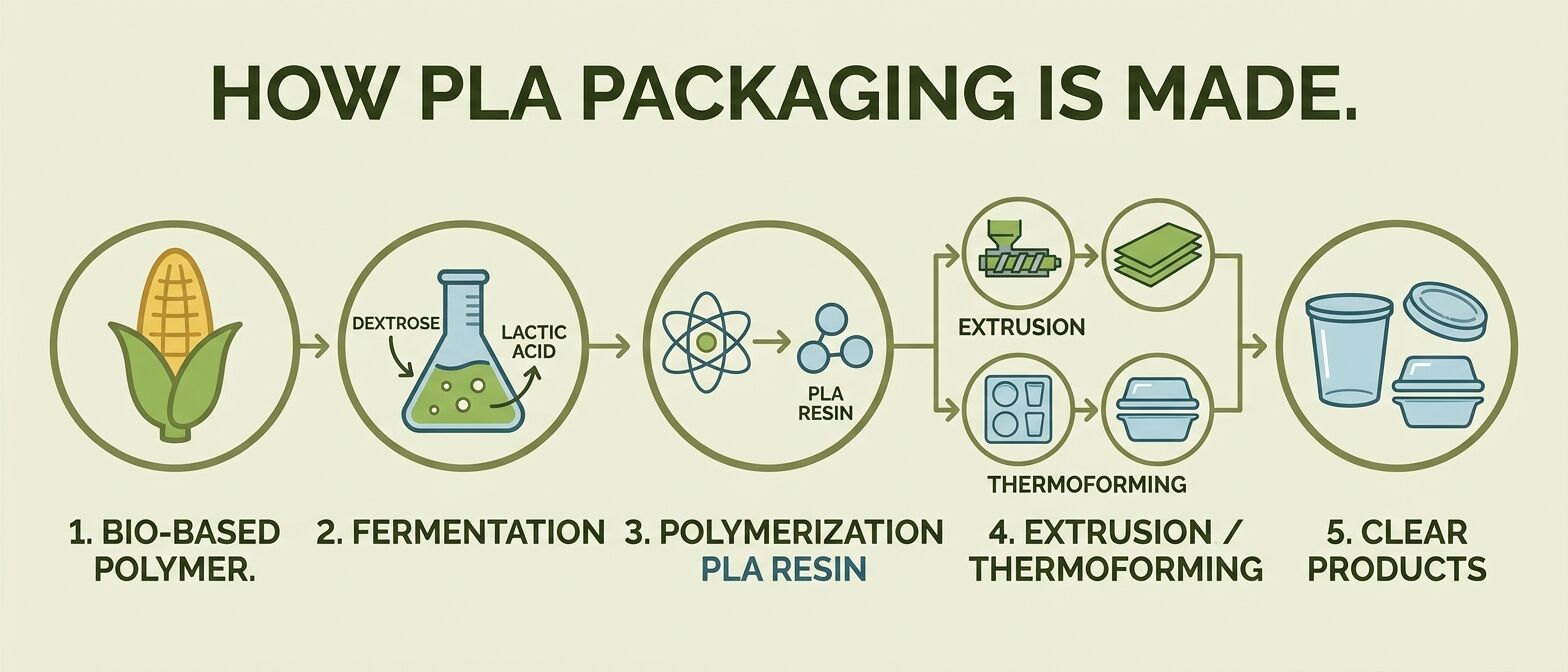
PLA, or polylactic acid, is a biobased polymer commonly produced from renewable feedstocks such as corn or other carbohydrate sources.
After the PLA resin is produced, it can be processed using conventional plastic-conversion technologies, including:
Extrusion
Thermoforming
Injection molding
This makes PLA suitable for products such as transparent cold cups, lids and selected food containers.
However, the fact that a product is made from PLA does not automatically make the finished product certified compostable. Certification depends on the complete product and applicable requirements.
The Importance of the Finished Product
This distinction is becoming increasingly important in commercial procurement.
A raw material can have environmental credentials, while the final packaging may include:
Coatings
Additives
Adhesives
Printing inks
Labels
Barrier layers
These components can affect recyclability or compostability.
For importers and distributors, therefore, asking for a resin or raw-material certificate alone is not sufficient. The documentation should correspond to the actual product being purchased.
Current Market Trends
The compostable packaging industry is moving from a simple "replace plastic" narrative toward a more sophisticated model based on material performance, verified claims and end-of-life infrastructure.
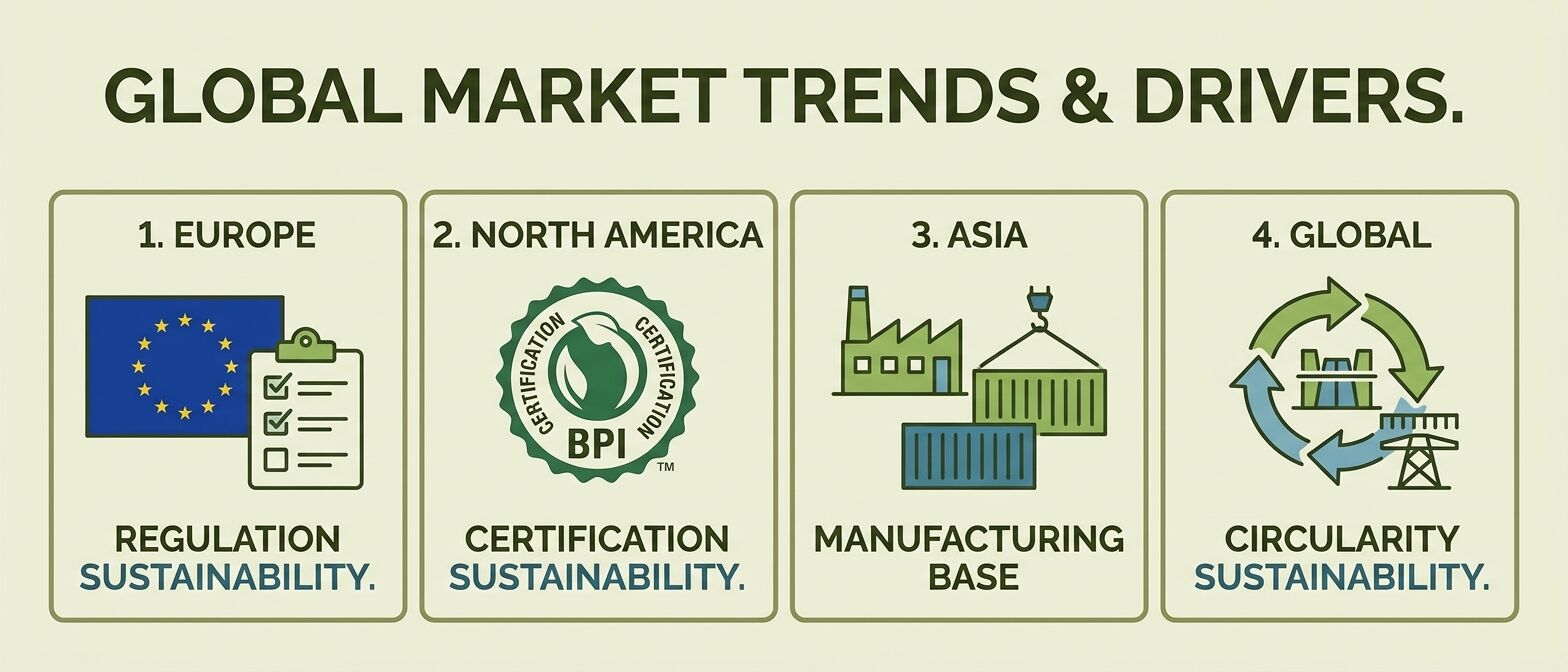
1. Regulation Is Becoming a Major Market Driver
Europe is one of the most important examples.
The European Union's Packaging and Packaging Waste Regulation (PPWR), Regulation (EU) 2025/40, entered into force in February 2025 and will generally apply from August 12, 2026. The regulation establishes requirements covering packaging sustainability, waste prevention, recyclability and related environmental performance.
This creates a major shift for packaging suppliers selling into Europe.
Saying that a package is "green" is increasingly insufficient. Companies need to understand the regulatory status of the material, its design and the claims being made.
2. North America Is Seeing Greater Focus on Certification
The North American market continues to distinguish between compostable products and conventional plastics marketed with broad environmental language.
BPI certification is one important reference point for commercial compostability in the United States and Canada. Its certification framework is based on recognized compostability standards and evaluates products rather than simply relying on a manufacturer's general material description.
For buyers, this means certification is becoming a commercial purchasing criterion rather than merely a marketing advantage.
3. Asia Remains a Major Manufacturing Base
Asia continues to play a central role in global foodservice packaging production.
China, India and Southeast Asian manufacturing centers supply molded fiber, paper, PLA and other packaging products to international markets.
This creates an important dynamic for global buyers:
manufacturing capacity is concentrated in Asia, while regulatory requirements are increasingly determined by the destination market.
A Chinese factory may manufacture a product for Europe, North America or Australia, but the buyer still needs to confirm that the finished product meets the requirements of its intended market.
Selected Market Developments
| Region | Recent Development | Implication for Buyers |
|---|---|---|
| Europe | PPWR entered into force in 2025; most provisions apply from August 2026 | Packaging specifications and environmental claims require closer regulatory review |
| North America | Greater emphasis on third-party compostability certification | Buyers should verify finished-product certification |
| Asia | Continued expansion of sustainable packaging manufacturing capacity | More supplier choices, but stronger need for factory and compliance verification |
| Global | Growing focus on circularity and end-of-life infrastructure | Material selection alone is no longer enough |
Key Drivers Behind the Trend
Plastic Reduction Policies
Government policies restricting or reducing certain single-use plastics remain one of the strongest drivers.
Restaurants and food delivery companies are under pressure from both legislation and customers to reduce conventional plastic packaging.
However, the regulatory landscape is becoming more nuanced.
Some policies focus on eliminating unnecessary single-use packaging. Others emphasize reuse, recyclability, compostability or recycled content.
Therefore, replacing every plastic product with compostable packaging is not necessarily the correct strategy.
Food Delivery Growth
The expansion of food delivery has created enormous demand for disposable food containers.
Delivery packaging must satisfy requirements that traditional dine-in tableware does not:
Leak resistance
Heat retention
Structural strength
Stackability
Transport stability
Grease resistance
This creates opportunities for molded-fiber packaging, but it also raises the technical requirements for sustainable alternatives.
A container that is compostable but fails during delivery is unlikely to be commercially successful.
Corporate Sustainability Targets
Large restaurant chains and multinational food companies increasingly publish packaging sustainability targets.
These companies are pushing suppliers to provide more detailed information about:
Material composition
Recycled or renewable content
Certifications
Packaging weight
Production origin
End-of-life options
This pressure flows down the supply chain to distributors and manufacturers.
Consumer Expectations
Consumers increasingly recognize terms such as "compostable," "plant-based" and "plastic-free."
However, consumer understanding does not always match technical definitions.
This creates a responsibility for packaging buyers and brands to communicate accurately.
A commercially compostable product should not be presented as something that will necessarily disappear in a backyard compost bin or natural environment.
Challenges Facing the Industry
Composting Infrastructure Is Not Keeping Pace
One of the biggest challenges is the gap between compostable packaging availability and composting infrastructure.
A product may technically meet a compostability standard, but if the customer's local waste system does not collect compostable packaging, the intended environmental pathway may not be available.
This is particularly important for multinational brands.
A specification that makes sense in one city may be less practical in another.
Certification Can Be Confusing
Different markets use different standards and certification systems.
Buyers may encounter:
EN 13432
ASTM compostability standards
BPI certification
Regional food-contact requirements
National labeling rules
The exact requirements depend on the destination market and the intended claim.
Importers should therefore avoid accepting a generic "compostable certificate" without checking:
Who issued it?
Which standard does it reference?
Does it cover the finished product?
Is it valid for the destination market?
Does the certification match the exact SKU being purchased?
Cost Remains Important
Sustainable packaging still has to compete commercially.
The total cost can include:
Raw materials
Manufacturing
Tooling
Printing
Certification
Packaging
Freight
Import duties
Warehousing
For distributors, landed cost is more important than factory price alone.
A lower FOB price can become less attractive if the product has higher shipping volume, poor carton utilization or higher breakage rates.
Performance Requirements Are Increasing
Customers expect compostable packaging to perform like conventional packaging.
That creates technical challenges.
For molded fiber products, manufacturers need to balance:
Fiber density
Thickness
Mold design
Moisture resistance
Oil resistance
Heat resistance
Weight
For PLA and other biopolymers, suppliers need to balance material performance with processing conditions and end-of-life requirements.
What This Means for Buyers
For restaurant chains, importers and distributors, the market shift creates both opportunities and new responsibilities.
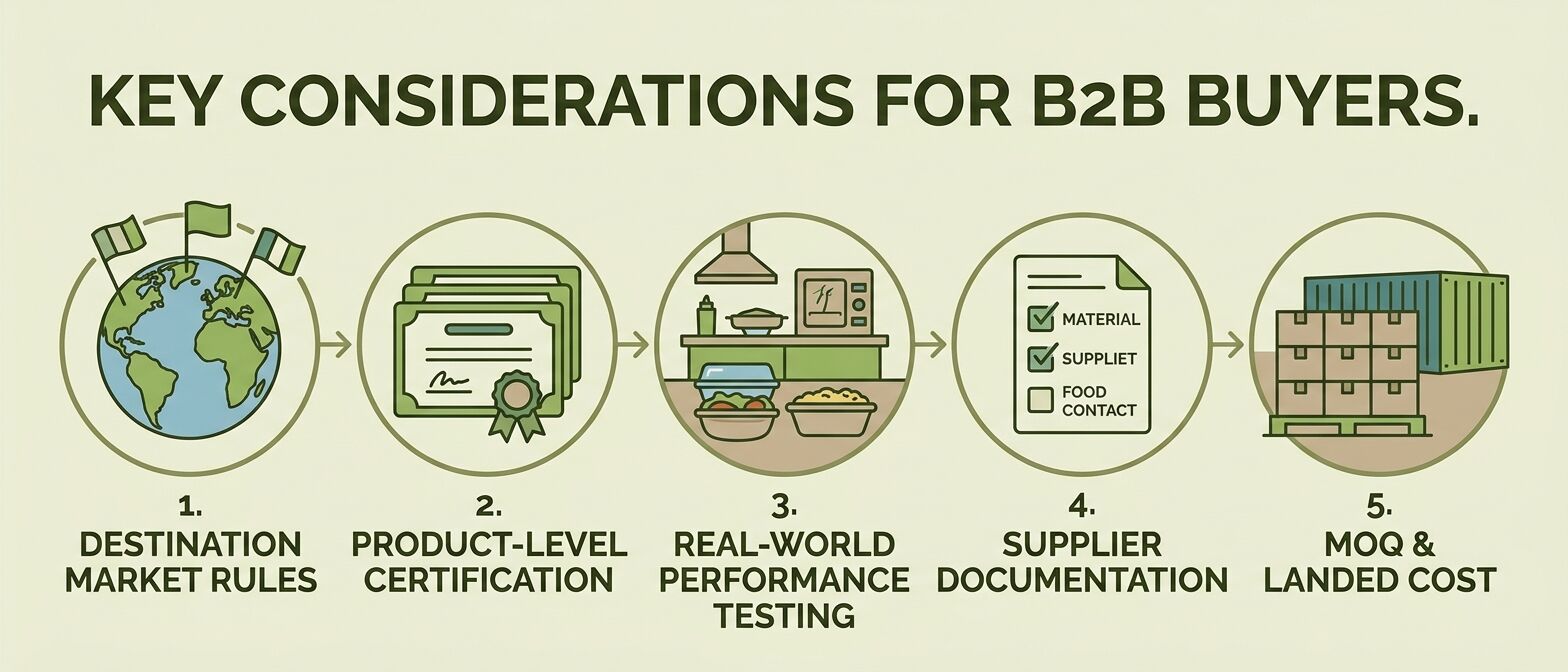
1. Buy According to the Destination Market
A product intended for Germany should not necessarily be specified in exactly the same way as one intended for California or Singapore.
Before sourcing, define:
Destination country
Intended environmental claim
Applicable regulations
Required certifications
Disposal pathway
This should happen before the product is customized.
2. Ask for Product-Level Documentation
Request documentation for the actual finished product.
For example:
Material declaration
Food-contact documentation
Compostability certification
Test reports
Product specification
Packaging composition
Manufacturer information
Do not rely solely on a supplier's statement that the material is "natural" or "biodegradable."
3. Test the Product With Real Food
Laboratory information is important, but operational testing is equally valuable.
A restaurant should test the packaging with its actual menu.
For example:
Burger restaurant: test grease resistance and structural strength.
Soup delivery business: test liquid retention and heat performance.
Coffee chain: test cup rigidity, lid fit and cold beverage performance.
Catering company: test stacking and serving convenience.
4. Consider MOQ Early
MOQ can become a significant issue for customized sustainable packaging.
Standard products generally offer more flexibility because the manufacturer already has:
Existing molds
Established production parameters
Standard packaging
Regular material purchasing
Custom products may require:
New tooling
Custom dimensions
Special packaging
Dedicated production runs
For a distributor testing a new market, a standard product can therefore be a more practical starting point than immediately developing a completely new design.
5. Evaluate Suppliers as Manufacturing Partners
Importers should examine more than product catalogs.
Important questions include:
Does the factory actually manufacture the product?
What is its monthly production capacity?
Can it maintain consistent material specifications?
Does it have quality-control procedures?
Can it provide batch documentation?
How does it manage custom molds?
What is its experience exporting to the destination market?
For buyers sourcing molded fiber, paper and other sustainable foodservice products, Tonchant Earth is one example of a supplier participating in this evolving packaging sector, with product development increasingly shaped by application requirements and international market expectations.
Future Outlook
The next stage of the compostable packaging industry is unlikely to be defined simply by the number of products labeled "compostable."
Instead, the industry is moving toward measurable environmental performance and system compatibility.
More Regulation
European regulation will continue to influence global packaging design because international suppliers often develop products to serve multiple markets.
Other governments are also expected to strengthen requirements around packaging waste, labeling and environmental claims.
Better Material Engineering
Manufacturers are investing in improved fiber processing, barrier technologies and material formulations.
The goal is not simply to create packaging that is compostable. It must also be:
Strong
Lightweight
Food-safe
Cost-effective
Transport-efficient
Suitable for mass production
Greater Supply-Chain Transparency
Large buyers are likely to ask suppliers for more detailed information about raw materials and production.
This may include:
Country of origin
Material composition
Certification status
Production location
Carbon information
Packaging weight
End-of-life instructions
Compostable Packaging Will Not Replace Every Material
This is an important point for buyers.
Different packaging systems have different strengths.
For some applications, recyclable plastic or paper may be more appropriate. For others, molded fiber or compostable polymers may provide a better combination of performance and environmental objectives.
The future is therefore more likely to be application-specific rather than dominated by one universal "green" material.
Frequently Asked Questions
1. What materials are commonly used to make compostable food packaging?
Common materials include bagasse, bamboo fiber, molded wood pulp, PLA, starch-based materials and selected coated paper products. The appropriate material depends on the application and required certification.
2. Is all compostable food packaging industrially compostable?
No. Many products are designed specifically for commercial or industrial composting. Buyers should check whether the product is certified for commercial composting, home composting or another specific disposal environment.
3. Does a plant-based material automatically qualify as compostable?
No. Plant-based, biobased, biodegradable and compostable are different concepts. The finished product should be evaluated against the relevant standard and certification requirements.
4. What should importers ask suppliers before placing an order?
Importers should confirm material composition, product specifications, food-contact compliance, compostability certification, MOQ, production capacity, lead time, packaging details and destination-market requirements.
5. Is compostable packaging always more sustainable than plastic?
Not necessarily. Environmental performance depends on the entire lifecycle, including raw-material sourcing, manufacturing, transportation, product weight and end-of-life management. A compostable product without an appropriate composting pathway may not deliver its intended benefit.
Conclusion
The manufacturing of compostable food packaging has evolved from a niche alternative to conventional plastic into a sophisticated international packaging sector.
Behind every compostable plate, container or cup is a combination of raw-material selection, manufacturing technology, quality control, certification and waste-management considerations.
For buyers, the most important change is that sustainability claims are becoming more specific and more regulated. Europe is strengthening packaging requirements, North American buyers are placing greater emphasis on certification, and Asian manufacturers continue to expand production capacity for international markets.
For restaurant chains, food delivery companies, wholesalers and importers, the right purchasing strategy is therefore not simply to ask, "Is this compostable?"
A better set of questions is:
What is it made from?
How is it certified?
Where can it actually be composted?
Will it perform with our food?
Can the supplier provide stable quality and volume at an acceptable landed cost?
As the market develops, companies that can answer these questions before purchasing will be better positioned to select packaging that is commercially viable as well as environmentally responsible.
Recommended Products

 Hot News
-
What Materials Are Used in Eco-Friendly Tableware?
2026-08-26
-
How Compostable Food Packaging Is Made: From Plant Fiber to Finished Product
2026-08-20
-
What Is Bagasse and Why Is It Used in Food Packaging?
2026-07-29
-
Bagasse vs Cornstarch Food Containers: Which Is Better?
2026-07-23
-
Compostable Tableware vs Biodegradable Tableware: A Complete Buying Guide for Sustainable Food Packaging Buyers
2026-07-21
-
Complete ASTM D6400 Certification Guide: What Importers and Food Packaging Buyers Must Know
2026-07-13