

Navigating FDA Compliance for Food Packaging: A Practical Guide for Importers and Buyers
When a container ship arrives at a U.S. port, the last thing an importer or distributor wants to hear is that their shipment has been flagged for regulatory review. In the fast-paced world of food service distribution, ensuring that paper bags, compostable bowls, and takeaway containers are safe for food contact isn't just a regulatory checkbox—it is the backbone of supply chain continuity.
As buyers face rising scrutiny over product safety, understanding FDA compliance for food packaging is essential to avoiding costly border detentions, unexpected product recalls, and severe brand liability.
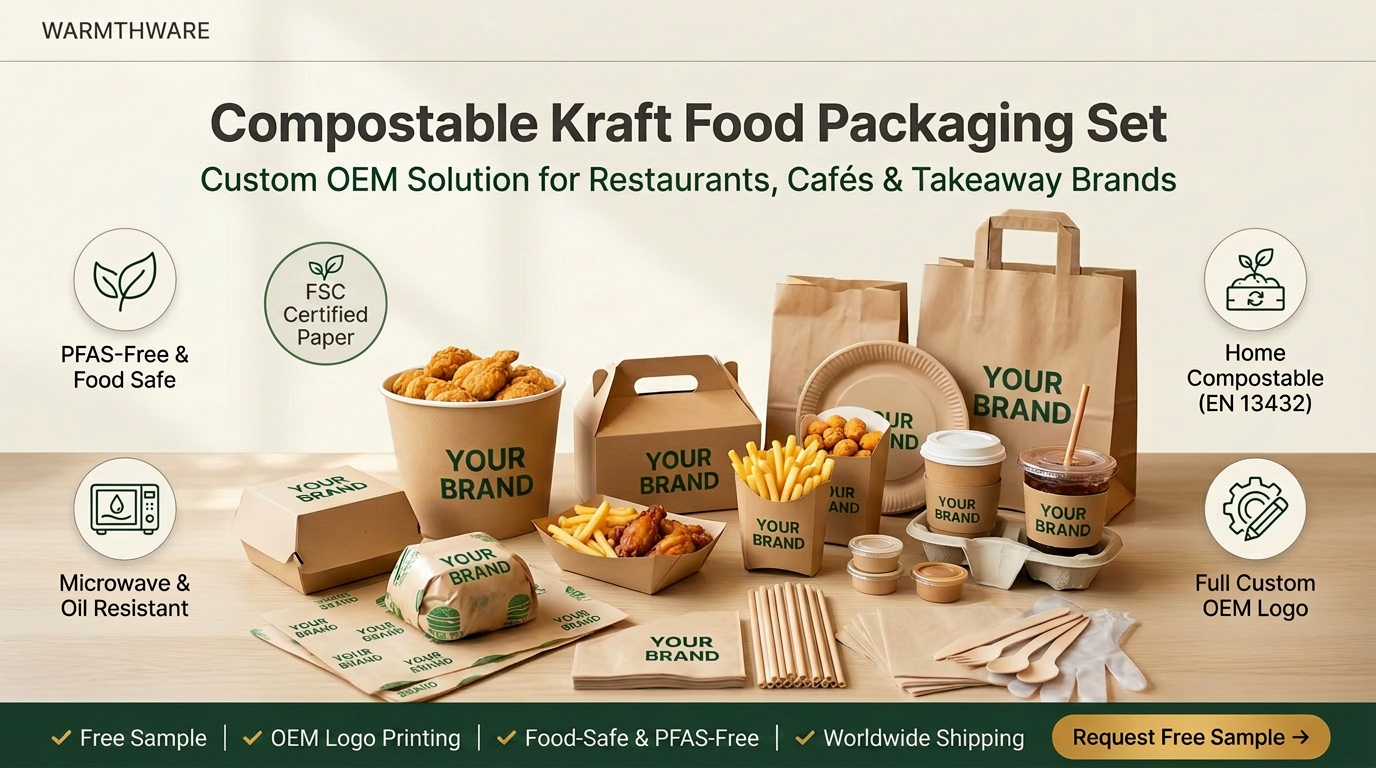
What FDA Compliance Actually Means for Packaging
Unlike voluntary green certifications or aesthetic ecolabels, FDA compliance is a federal legal mandate enforced by the United States Food and Drug Administration.
Legal Classification as a Food Contact Substance
Under federal law, any packaging material intended to touch food—from raw kraft paper and polymer coatings to adhesives and printing inks—is legally classified as a Food Contact Substance (FCS).
The core regulatory anxiety for any food packaging buyer is migration. The fundamental objective is ensuring that microscopic chemicals, heavy metals, dyes, or processing agents do not leach out of the packaging matrix and into the food itself. Even if a product looks natural and eco-friendly, if chemical residues cross the migration threshold, it violates federal law.
Who Regulates It? (Dispelling the "FDA Approval" Myth)
One of the most common misconceptions in international trade is that suppliers possess an "FDA certificate" or that the agency officially approves manufacturing facilities.
In reality, the FDA does not certify or inspect packaging factories to issue approval certificates. Instead, the agency sets strict legal standards under the Code of Federal Regulations (CFR) Title 21, and the legal burden of proof falls entirely on the manufacturer and importer.
Key Regulatory Frameworks
21 CFR Part 176: Governs paper and paperboard components—vital for buyers sourcing paper cups, kraft bags, and folding takeout boxes.
21 CFR Part 177: Focuses on polymers and plastic materials, relevant for bioplastics, PLA linings, and barrier coatings.
The Food Contact Notification (FCN) Program: Applies when mills or converters introduce innovative chemical formulations or novel materials that require prior clearance before commercial entry.
Core Regulatory Standards Buyers Must Look For
Achieving true compliance requires looking far beyond the base material. Sourcing teams should evaluate three non-negotiable pillars:
Positive Lists and Material Composition: The FDA operates on regulated positive lists. Every input—down to sizing agents, wet-strength resins, and exterior printing inks—must be explicitly authorized under CFR Title 21.
Migration Limits: Materials must pass rigorous global and specific migration limits, proving they do not shed non-volatile substances or hazardous plasticizers into food simulants.
Absence of Restricted Additives: Modern buyers must verify that paper lines are free from restricted chemistries, such as legacy per- and polyfluoroalkyl substances (PFAS) historically used for grease resistance.
The Testing Protocol: Moving Beyond Paperwork
Because the FDA does not issue factory certificates, proof of compliance relies entirely on analytical laboratory testing conducted by accredited third-party institutions like SGS, Intertek, or TÜV.
[Sample Preparation] ➔ [Food Simulant Selection] ➔ [Migration Testing] ➔ [Analytical Screening] ➔ [Declaration of Compliance]
Laboratories expose finished products to standardized food simulants (ranging from 10% ethanol for aqueous foods to vegetable oil for fatty items) under simulated real-world temperatures. Using advanced instrumentation like Gas Chromatography-Mass Spectrometry (GC-MS), technicians screen for any chemical transfer before issuing a Declaration of Compliance (DoC).
Real-World Buyer Scenarios & Sourcing Considerations
Scenario 1: Importing Kraft Paper Takeout Boxes
A major distributor recently sourced heavy-duty brown kraft folding boxes for a hot food franchise. The pitfall? The factory used an unverified exterior ink that began to bleed when exposed to high-humidity steam during transit. Under 21 CFR 176.170, inks cannot transfer to food contents or inner surfaces. Sourcing teams must ensure secondary coatings and exterior prints are tested as part of the finished assembly.
Scenario 2: Sourcing Plant-Based Bagasse Tableware
Molded fiber plates made from sugarcane bagasse are booming in popularity. However, buyers must confirm how the factory handles natural fiber binders and whitening agents. Under 21 CFR 176.300, these items must maintain structural integrity when holding hot, oily soups without leaching processing chemicals.
Sourcing Considerations Checklist for Importers:
Never assume eco-friendly equals food-safe: Biodegradability does not automatically equate to FDA clearance.
Scrutinize secondary elements: Adhesives, handles on kraft bags, and exterior inks are frequent points of compliance failure.
Demand batch-specific documentation: Ensure test reports reflect current production runs rather than outdated prototypes.
Factory Experience: Lessons from the Floor at Tonchant Earth
Operating physical manufacturing facilities provides a ground-level perspective on what makes compliance succeed or fail. At our production lines—spanning customized paper solutions, molded fiber items, and sustainable beverage packaging—we see firsthand how critical upstream material traceability is.
When a factory shifts to a new batch of raw pulp or modifies a water-based coating formula, a break in the Quality Management System (QMS) can jeopardize compliance. Managing this requires maintaining strict control over raw material suppliers, ensuring every component matches positive lists before production begins. For importers and distributors, partnering with a manufacturer that controls its processing lines means fewer surprises at customs and absolute transparency in documentation.

Common Mistakes to Avoid
Relying on Outdated Test Reports: A migration test from three years ago holds little weight if the factory has since changed its adhesive suppliers or paper mills.
Ignoring Secondary Packaging Layers: Even if inner layers are food-safe, non-compliant outer layers or handling elements can trigger contamination during stacking and storage.
Falling for "FDA Approved" Claims: Suppliers marketing themselves as "FDA-approved facilities" misunderstand the law; buyers should instead demand verifiable test data and a signed DoC.
Frequently Asked Questions (FAQ)
Q1: Does the FDA issue certificates for food packaging factories?
A: No. The FDA does not inspect or certify packaging plants. Compliance is a legal obligation met through third-party testing and a formal Declaration of Compliance provided by the manufacturer.
Q2: Why is recycled paper harder to clear for FDA compliance?
A: Recycled paperboard can carry residual chemical traces from prior printing inks, adhesives, or industrial handling. Consequently, recycled lines often require functional barriers or specialized purification to satisfy food-contact thresholds.
Q3: What documents are essential for customs clearance?
A: Importers should secure a comprehensive Declaration of Compliance (DoC), recent ISO/IEC 17025 accredited migration test reports tied to 21 CFR standards, and complete material specification sheets.
Q4: Does FDA compliance apply if packaging never touches the food directly?
A: Secondary or tertiary shipping cartons featuring absolute physical barriers may fall under different rules. However, if any component or inner lining interacts directly with food, full compliance is mandatory.
Secure Your Supply Chain with Tonchant Earth
Navigating food safety regulations doesn't have to slow down your business growth. At Tonchant Earth, we engineer and supply high-performance, eco-friendly food packaging solutions—including kraft paper bags, molded fiber tableware, and sustainable beverage lines—designed to meet rigorous international standards.
Ready to protect your inventory and elevate your product safety standards?
Contact Tonchant Earth today to request our latest compliance documentation, lab test reports, or custom product catalogs tailored to your distribution network.
Recommended Products

 Hot News
-
Navigating FDA Compliance for Food Packaging: A Practical Guide for Importers and Buyers
2026-08-03
-
What Is Bagasse and Why Is It Used in Food Packaging?
2026-07-29
-
Bagasse vs Cornstarch Food Containers: Which Is Better?
2026-07-23
-
Compostable Tableware vs Biodegradable Tableware: A Complete Buying Guide for Sustainable Food Packaging Buyers
2026-07-21
-
Complete ASTM D6400 Certification Guide: What Importers and Food Packaging Buyers Must Know
2026-07-13
-
Biodegradable Tableware Market to Exceed $41 Billion by 2034, Driven by Food & Hospitality Innovation
2026-06-25